 LotsAgent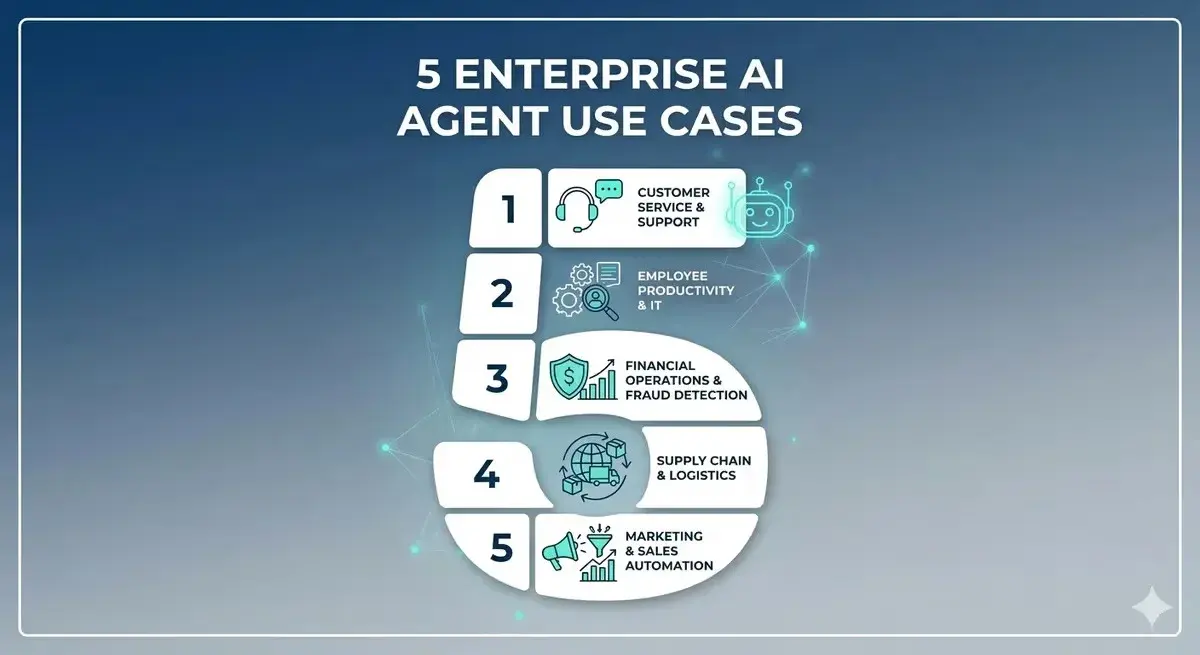
Here's a number that'll make your CFO's eyes light up: 171%.
That's the average ROI enterprises are pulling from AI agents in production. In the US? It's even better—192%. With a payback period of just 8.3 months, the math is settled.
But here's the plot twist nobody talks about: 79% of enterprises have adopted AI agents, yet only 51% actually run them in production. That 28-point gap? It's the biggest opportunity you're probably leaving on the table.
The good news: where AI agents are deployed, the results are undeniable. Let's break down the five enterprise deployments generating measurable, compounding ROI right now.
1. Customer Service: The $3.50 Per Dollar Return
Customer service remains the top dog for AI agent deployment—and the numbers justify why.
Organizations running AI agents for support are reporting $3.50 returned for every $1 spent. Contact center costs? Down 20-40%. Resolution times? Cut by 87% in some deployments. And here's the kicker: AI agents now handle 80% of routine inquiries without human intervention.
Salesforce Agentforce 3.0 is leading this charge. Their latest release manages end-to-end sales workflows—invoice processing, customer queries, order tracking—cutting invoice cycles by 80% for Oracle Fusion users.
The shift isn't about replacing humans. It's about removing the repetitive work that burns out your best agents. AI handles first-line triage, refund processing, and FAQ resolution. Your human team handles the complex cases that actually need empathy and judgment.
By 2028? Gartner predicts most customer support journeys will start with conversational AI. Your competitors who figured this out are already at scale.
2. Financial Operations: Saving $150 Billion Across the Industry
Financial services have the highest AI adoption rate at 91%—and they're seeing the fastest payback.
The ROI is concrete: 26-31% cost savings across finance operations through automated compliance monitoring, fraud detection, and customer service. Healthcare alone is projected to save $150 billion in 2026 through AI agent deployments.
JPMorgan Chase is a poster child here. Their AI agents handle 360,000 manual hours annually—that's equivalent to 173 full-time employees working 40 hours a week. All that time? Redirected to higher-value analysis and client relationship work.
What are these agents actually doing?
- Real-time transaction monitoring and fraud flagging
- KYC compliance automation
- Invoice matching and accounts payable
- Regulatory reporting and audit prep
The finance teams winning aren't just automating tasks. They're building agent workflows that maintain audit trails, survive disconnects, and execute multi-step processes without losing context.
3. Sales & Marketing: 3x Faster Pipeline Velocity
Sales teams deploying AI agents are seeing 3x faster responses and 15-30% productivity gains. That's not incremental improvement—that's competitive advantage.
The playbook that's working:
- Prospect research at scale: AI agents analyze 500+ prospects weekly, pulling firmographics, news, and social signals
- Personalized outreach: Drafting emails that actually feel human because the agent knows the prospect's context
- CRM hygiene: Updating records, logging activities, maintaining pipeline hygiene without manual entry
- Follow-up automation: Scheduling demos and follow-ups based on engagement signals
One B2B SaaS company using Databricks agents for their retailer operations (3,000 locations) now generates real-time store insights that used to take analysts days to compile.
The result? Sales cycles shortened 18%. Reps spend less time on data entry and more time on conversations that actually close deals.
4. IT & DevOps: From Firefighting to Prevention
Enterprise IT teams are deploying AI agents for infrastructure monitoring, incident triage, and automated remediation—and the results are game-changing.
Mean time to resolution (MTTR) dropped 45% for cloud infrastructure providers running AI agents in production. Why? Because agents can:
- Detect anomalies across thousands of system metrics simultaneously
- Correlate alerts that would take humans hours to piece together
- Execute predefined runbooks for common failure patterns
- Maintain full context across multi-hour incidents
Unity Technologies saved $1.3 million annually by deploying AI agents for their DevOps workflows. DHL cut operational costs 15% through supply chain AI agent orchestration.
Siemens reduced maintenance costs 30% using predictive agents that catch equipment failures before they happen.
The secret? Durable execution. AI agents that survive disconnects, maintain state across sessions, and log every action for compliance review. Because when your agents are handling production infrastructure, audit trails aren't optional—they're mandatory.
5. Human Resources: 12 Agents Per Organization
Here's a stat that surprises people: enterprises are now running an average of 12 AI agents per organization. And HR is proving agents aren't just for tech teams.
The HR use cases generating ROI:
- Resume screening: Consistent criteria applied across 1,200+ applications without fatigue
- Interview scheduling: Cross-timezone coordination that used to take days, now automated
- Onboarding coordination: Welcome sequences, equipment requests, compliance training—automated
- Policy Q&A: Benefits questions answered 24/7, freeing HR for strategic work
One manufacturing company with 2,000 employees deployed AI agents for campus recruiting. Result: time-to-hire dropped 30%, and recruiting team hours on admin tasks fell by half.
The winning formula? Start with high-volume, repetitive workflows where humans spend time on tasks that don't need human judgment. Build from there.
The Pattern: Where AI Agents Actually Win
After analyzing hundreds of enterprise deployments, the pattern is clear:
High-ROI deployments are task-specific, not broadly autonomous. They're integrated into existing workflows—CRM, ERP, service platforms—and governed with human-in-the-loop controls.
Enterprises crushing it with AI agents share three characteristics:
- Clear KPIs from day one: Automation rates, cost savings, resolution times, accuracy improvements
- Integration over experimentation: Connected to systems that actually matter to the business
- Governance built in: Audit trails, access controls, escalation paths
The gap isn't technology. It's knowing where to deploy and how to integrate.
Your Turn
The ROI data is irrefutable. AI agents in production deliver measurable, compounding returns. The question is no longer whether—it's where to start.
If you're evaluating enterprise AI agent deployment, begin with your highest-volume, most repetitive workflow. Customer service, invoice processing, IT monitoring. Get that right first. Expand from there.
LotsAgent lets enterprises deploy AI agents with built-in identity, persistent memory, and full audit trails. Connect to 100+ apps via OAuth, use any AI model, and scale across channels—from email and Telegram to webhooks and REST API.
The 51% of enterprises already running AI agents in production? They're not looking back.
What enterprise workflow would you automate first?