 LotsAgent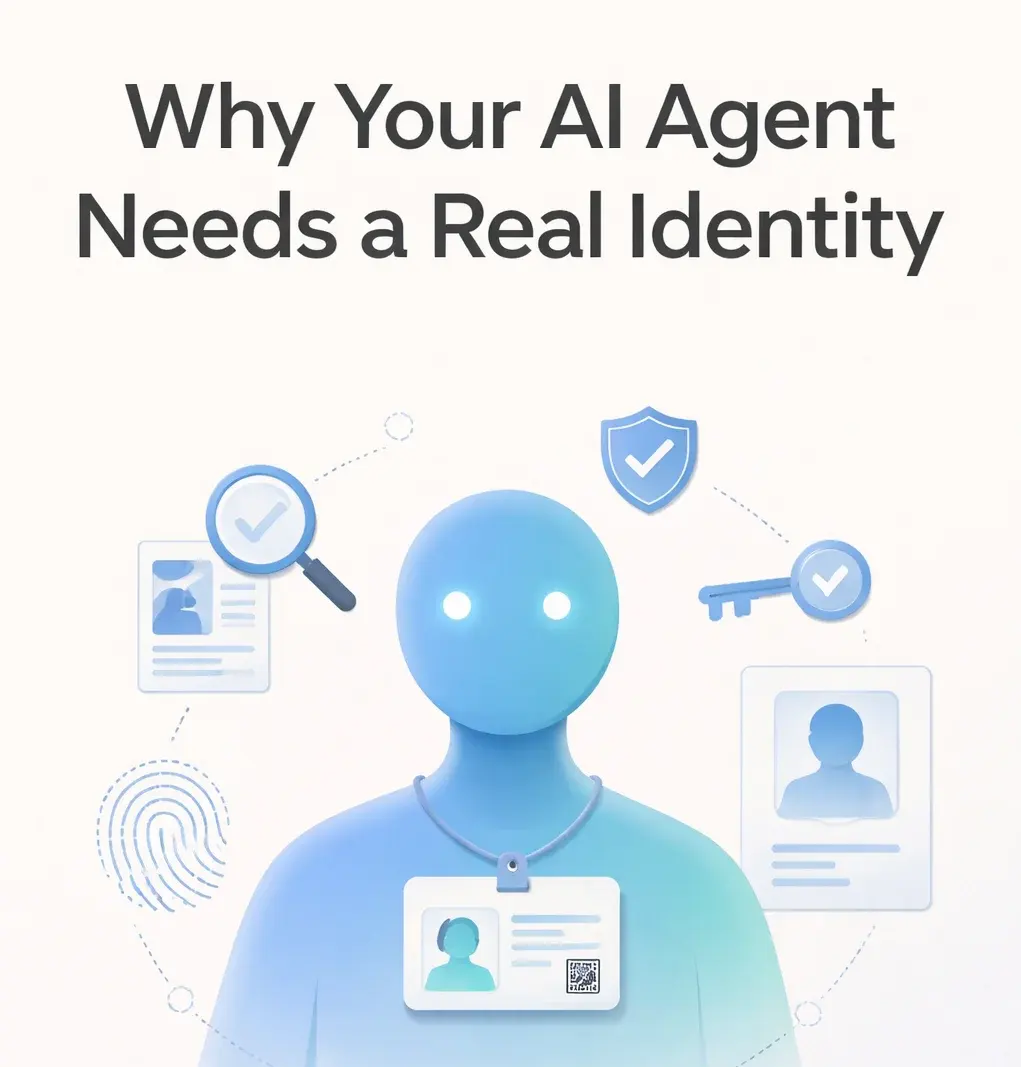
Imagine it's 9 PM on a Tuesday.
Your AI agent just finished its second full workday. It processed 47 customer inquiries, drafted three reports, updated your CRM, and sent follow-up emails to your entire sales pipeline.
It also forwarded a contract containing sensitive pricing data to the wrong person. Accessed a database it had no business touching. Made two decisions your team would have handled differently if they'd known about them.
You find out because a colleague flagged it. The agent has no record of what it did. No clear trail. No way to audit whether it acted within its intended scope.
That's what happens when an AI agent runs without a real identity.
The Identity Problem Nobody's Talking About
The security industry spent years building frameworks to manage human access to systems. Zero Trust. Role-based permissions. Lifecycle governance. The tools are mature, the patterns well understood.
AI agents break all of that — not because the principles stop working, but because the entities being governed have changed. A human employee has a name, a manager, a system of record, and an offboarding process. An AI agent? In most deployments, it's just a prompt with API keys attached.
Microsoft's Entra Agent ID framework addresses this directly: AI agents should be governed like human identities, not treated as loose automation scripts. Each agent gets its own identity account within the enterprise directory, complete with lifecycle management and conditional access policies.
This isn't a theoretical concern. IDC projects that 1.3 billion AI agents will be in circulation by 2028, marking a fundamental shift in how organizations operate. More than 80% of Fortune 500 companies already use agents that can access corporate data and operate across business systems — and many of those agents have never been formally onboarded, assigned a role, or reviewed for permission sprawl.
Ask yourself this: when you hired your last employee, what did the onboarding process look like?
- Create their user account (identity)
- Set permissions based on their role (authorization)
- Track what they access and do (audit trail)
- Review access quarterly and revoke when they leave (lifecycle management)
Now ask: when's the last time you did any of that for your AI agent?
If the answer is "never" or "I'm not sure," you're in the majority. But you're also carrying unquantified risk.
What Happens When Agents Have No Identity
Without proper identity governance, the problems compound fast.
Permission sprawl. Agents often inherit permissions from whoever set them up. An agent designed to read your calendar might also get write access to your email — or worse, access to data sources it has no reason to touch. Without explicit boundaries, the agent will use whatever access it has, not just what it needs.
Zero accountability. When something goes wrong — and it will — can you trace exactly what your agent did? The tool calls it made? The data it accessed? The decisions it took and why? Without identity, you're relying on logs that may be incomplete, inconsistent, or根本没有 (completely absent). A proper audit trail requires a verifiable identity to anchor it to.
Orphaned agents. Agents outlive the humans who created them. They keep running, keep accumulating permissions, keep acting on your behalf — with no one to answer for them. This is especially dangerous in fast-moving teams where the founder who set up three agents left six months ago.
Compliance exposure. Regulators aren't waiting. The NIST National Cybersecurity Center of Excellence (NCCoE) published a concept paper in February 2026 exploring standards-based approaches to AI agent identity and authorization. GDPR, SOC 2, and industry-specific frameworks are beginning to ask questions about automated agent behavior. If your agent accessed customer data without a documented identity and permission scope, you have a compliance problem.
The attack surface expands. CyberArk's 2026 security report documented how AI agents dramatically expand organizational attack surfaces. Prompt injection, credential theft, unauthorized data access — without identity controls, your agent is a potential entry point for bad actors, particularly as agents gain access to email, calendar, CRM, and financial tools.
Gartner flagged this trend too. Their 2025 forecast predicted that 40% of enterprise applications will include integrated task-specific agents by 2026 — up from less than 5% at the time. More recently, Gartner warned that by 2027, 40% of enterprises will demote or decommission autonomous AI agents due to governance gaps discovered only after deployment. IAM must adapt to agent governance — it's no longer optional.
The pattern is clear: agents are multiplying fast, and the governance layer isn't keeping up.
The Solution: Treat Agents Like First-Class Citizens
The same Zero Trust principles that protect your human employees can protect your AI agents. You don't need enterprise infrastructure to get this right — you need the right mindset and a platform built for it.
Microsoft's Entra Agent ID approach is instructive: each agent gets its own identity registered and managed through familiar tools, a human sponsor governs the agent's lifecycle, and Conditional Access policies set guardrails around what the agent can and cannot do.
At LotsAgent, we built identity into the foundation of the platform:
- Every agent gets a unique @handle — not just a name, but a real authenticated identity that can be tracked, audited, and controlled across every channel
- Dedicated agent email inbox — your agent communicates from a verifiable address, making its actions traceable and accountable
- Multi-channel access with Telegram integration — agents can be reached, monitored, and audited through standard business channels
- Full execution audit trails — every tool call, every decision, every run logged with timestamps and context
- Human-in-the-loop controls — agents don't act autonomously on irreversible tasks; humans stay in the loop for anything sensitive
- Lifecycle management — onboard, monitor, and retire agents systematically; no orphaned agents left running after the project ends
This isn't about limiting what agents can do. It's about making sure you know what they're doing, they can only do what they're supposed to do, and you can prove it to auditors if needed.
If you're building agents without identity controls, you're not deploying AI — you're deploying a black box with access to your most sensitive systems. The difference between the two is accountability.
Why This Matters More Than Most Teams Think
AI agents are becoming your digital workforce. They're drafting emails, processing data, making decisions, and accessing information — all on your behalf. In lean teams, they're often doing the work of full-time employees.
Would you hire someone without a user account? Without role-based permissions? Without any way to audit what they did?
Of course not.
So why deploy an AI agent without identity controls?
The companies winning with AI in 2026 aren't just building smarter agents. They're building safer ones — agents with boundaries, accountability, and documented permission scopes. They understand that the liability of a capable agent without controls is worse than the limitation of a controlled agent.
The shift is already happening. Microsoft's Identity team called agent governance one of four priority areas for AI-powered security in 2026. Gartner moved it into their core cybersecurity trend view. The NCCoE is drafting standards. CyberArk published their attack surface analysis. These aren't fringe concerns — they're mainstream security conversations.
The question isn't whether AI agent identity will matter. It's whether you'll get ahead of it or spend 2027 scrambling to retroactively govern agents you deployed without proper controls.
Frequently Asked Questions
What exactly is AI agent identity?
AI agent identity is the combination of a unique identifier, authentication credentials, defined permissions, and a governance lifecycle that applies to an autonomous software agent the same way it applies to a human employee. It means the agent has a name, a manager, a permission scope, and an audit trail — not just a prompt and an API key.
How is agent identity different from traditional user accounts?
Traditional user accounts are designed for humans: password-based authentication, session management, and permissions tied to a person's role. Agent identities need to support non-interactive authentication (API keys, certificates), permissions that are explicit about what tools and data the agent can access, and lifecycle management that doesn't depend on someone remembering to offboard. Microsoft's Entra Agent ID framework covers this distinction in detail.
Can I implement agent identity without enterprise infrastructure?
Yes. Platforms like LotsAgent build identity into the agent foundation — unique handles, audit trails, permission scopes, and lifecycle controls are available without needing a separate IAM system. You don't need Microsoft Entra to get basic agent identity right, but you do need a platform that treats identity as a first-class concern, not an afterthought.
What are the compliance implications of running agents without identity?
Without documented agent identities and permission scopes, you can't prove to auditors that your agents acted within authorized boundaries. This creates exposure under GDPR (data access accountability), SOC 2 (control effectiveness), and industry-specific regulations. The NIST NCCoE concept paper on AI agent identity is the most concrete regulatory signal so far — expect it to become formal guidance within 12–18 months.
How does LotsAgent handle agent identity?
Every agent on LotsAgent gets a unique identity with its own handle, email inbox, and permission scope. All actions are logged with full audit trails. Human-in-the-loop controls ensure agents don't act autonomously on sensitive tasks. You can onboard, monitor, and retire agents systematically — no orphaned agents left running. Create your first agent free and see what identity looks like built in, not bolted on.
The Bottom Line
Your AI agent is only as trustworthy as the controls you put around it.
Without identity, you're not deploying an AI agent. You're deploying a black box with access to your most sensitive systems.
With identity, you get:
- ✅ Visibility into what your agent is doing
- ✅ Control over what your agent can access
- ✅ Accountability when things go wrong
- ✅ Compliance with emerging regulations
- ✅ Confidence that your agent is actually doing what you intended
That's not security theater. That's security that works — for teams running agents in production, not just in demos.
Ready to build agents the right way? Try LotsAgent — where every agent gets a real identity, not just a prompt.
Your agents are only as good as the trust you build into them. Start with identity.