 LotsAgent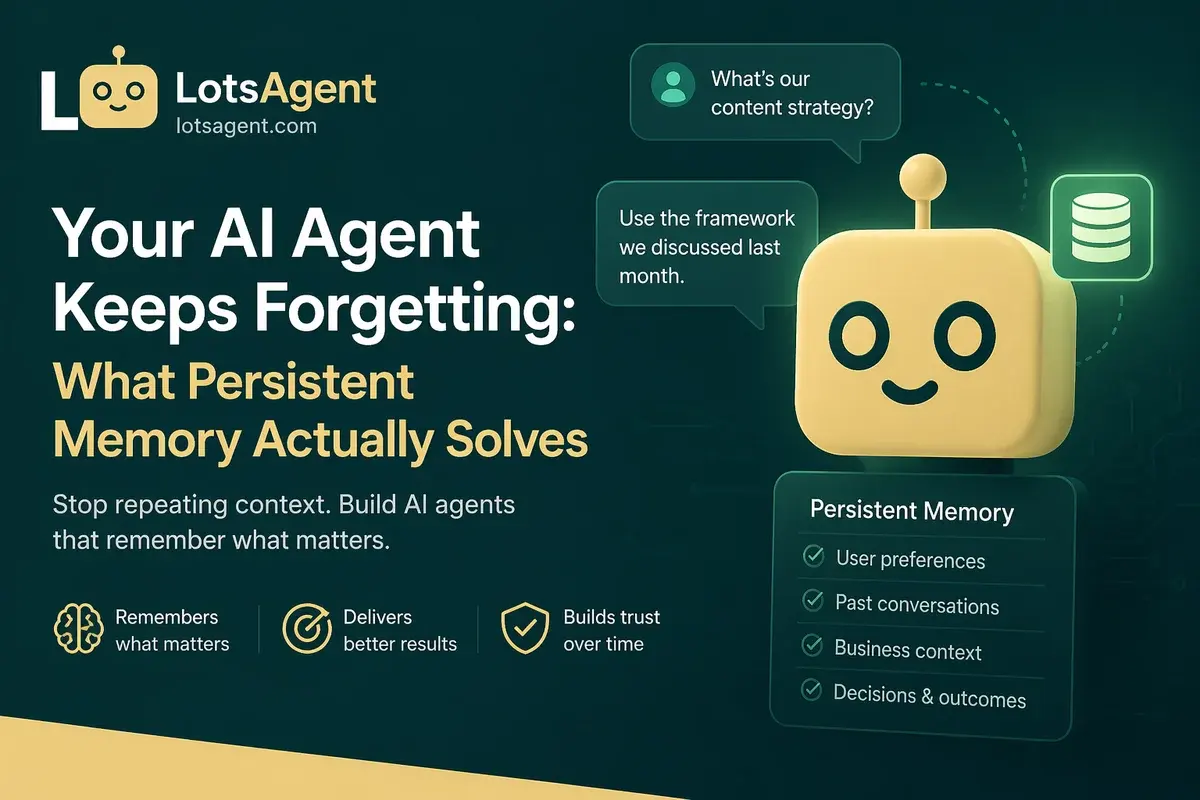
You built an AI agent. It works great — for one session.
Then you close the tab. Open it again. And it's like meeting someone brand new. No memory of what you discussed. No recall of what it was supposed to do. No context from your last session.
This isn't a minor inconvenience. This is the moment your "agent" becomes just another chatbot.
And if you've been running automation at any scale, you've probably already hit this wall.
The amnesia problem nobody talks about
The AI agent hype is real. But behind every demo is a quiet failure that nobody publishes: agents forget everything between sessions.
It shows up in ways that seem small until they're not:
- Your lead qualification agent has to re-learn what a qualified lead looks like every single morning.
- Your ops agent asks for context you gave it last week — again.
- Your social agent drafts content that contradicts your brand guidelines because it has no memory of them.
- Projects restart from zero because the agent doesn't know what state it left off in.
This is "sliding window amnesia" — a term practitioners use because it's exactly what it feels like. You have an agent that can reason brilliantly. But every new session, it starts cold. Like having an employee who resets every morning regardless of what they learned the day before.
And the thing that kills most teams isn't the concept. It's that the fix sounds complicated — you hear "vector databases," "embedding pipelines," "semantic retrieval," and you think: that's not my job.
So you don't fix it. And your agents plateau at simple tasks forever.
Why the tools you're using can't help
Let's be specific about what fails.
Zapier. No persistent agent state. Each automation runs in isolation. It was never designed to carry context across sessions — it's a flow execution engine, not an agent platform. You get reliable triggers and data moves. You don't get memory.
ChatGPT and generic AI assistants. Session-based context only. Close the conversation, lose everything. No cross-session recall, no customer profiles, no learned behaviour. Great for one-off tasks. Useless for ongoing work.
LangChain alone. Here's the trap a lot of builders fall into: LangChain gives you the framework. But persistence is on you. Most teams either skip it (leading to the amnesia problem) or build it incorrectly — token-bloated prompts, lossy summaries, entity fragmentation. The framework doesn't solve the memory problem; it just hands you the parts and says "figure it out."
Building in-house. Even if you have the engineering bandwidth, building a proper memory system means solving storage, retrieval, entity continuity, temporal reasoning, and governance — simultaneously. That's weeks of work before your agent does anything useful.
The common thread: none of these approaches were built to remember.
What persistent memory actually solves
Here's the shift. Persistent memory isn't about having a bigger context window. It's about having a durable knowledge layer your agent can read from and write to — across every session, every tool call, every workflow.
A platform with true persistent memory does three things:
1. It remembers what your agent learned — not just what was said This means it stores decisions, preferences, and patterns — not just transcripts. Your lead qualification agent learns that "enterprise deals in healthcare take 3x longer." Your ops agent knows which suppliers you've already rejected. The agent improves over time, not just within a session.
2. It carries context across multi-day workflows Traditional automation breaks when a workflow pauses — waiting for a client response, a审批, a delivery update. Persistent memory lets an agent pick up exactly where it left off. Your agent can pause a complex workflow, wait 24 hours for human input, then resume with full context — something no workflow automation tool can do without custom engineering.
3. It compounds value over time Each session makes the agent smarter for the next one. Customer profiles deepen. Business rules clarify. The agent stops repeating mistakes because it actually remembers making them.
Databricks' production research found that agents with persistent memory improved accuracy from near-zero to 70% — eventually surpassing expert-curated baselines by 5%. On raw, noisy real-world data (no gold annotations), the agent hit 50% accuracy after just 62 examples — beating human expert performance. That's not a demo. That's a production result.
The failure nobody warns you about
There's a specific failure mode that catches people off guard: context rot.
Research from Chroma tested 18 frontier models — GPT-4.1, Claude 4, Gemini 2.5, Qwen3 — and found that every single model degrades in reliability as input length increases. Not just at token limits. Well before them. A model with a 200K context window starts degrading at 50K tokens.
The mechanism: as context grows, models can't use it uniformly. Performance becomes unreliable not because the window is full, but because the signal-to-noise ratio collapses. You get sliding context rot — where important details get lost not at the edge of the window, but in the middle of it.
This is why "just use a bigger model" doesn't solve the memory problem. Every major frontier model tested — 100% — showed this degradation pattern. Context window size is not the answer.
The answer is structured retention: storing what matters separately, retrieving it intelligently, and keeping the context window clean for what the agent needs right now.
What this looks like in practice
Here's how persistent memory shows up in a real workflow — the kind an automation-aware operator actually runs.
Lead qualification that gets smarter: Your agent reads an inbound lead. It qualifies them, routes them, drafts a response. Next week, when a similar lead comes in, it doesn't start from scratch. It knows that last month you deprioritised SaaS companies under 50 employees. It knows the threshold you set for deal size. It applies that learning — automatically.
Onboarding that picks up where it left off: Your customer onboarding agent is halfway through step 3 of 7 when the client goes quiet for three days. A traditional automation would reset. With persistent memory, it resumes with full context: which steps are done, what documents were submitted, what the client's stated goals are. It picks up the conversation naturally.
Ops workflows that handle exceptions: Your ops agent is processing a vendor invoice that doesn't match your records. With persistent memory, it can recall: "This vendor was flagged in Q3 2024 for overcharging on shipping." It doesn't just apply a rule — it applies learned judgment.
The key insight: memory turns rules into judgment. Without it, your agent is a flowchart. With it, it's a knowledgeable colleague.
Why most platforms still can't do this
If persistent memory is so valuable, why don't more platforms offer it?
Because it's genuinely hard. Building a memory layer means:
- Episodic memory (what happened, in what order, with what outcome)
- Semantic memory (learned facts, rules, preferences — the "what we know" layer)
- Entity resolution (knowing that "my PM," "Alice," and "Alice from product" are the same person)
- Temporal reasoning (knowing that "we switched vendors last quarter" means something about what to reject now)
- Token-aware retrieval (keeping the context window clean by fetching only what's relevant)
Most platforms offer one or two of these. None of them make it easy. The result is partial memory — which is almost worse than no memory, because it gives you false confidence.
The fix is built in, not bolted on
Here is what LotsAgent does differently.
Persistent memory is a first-class feature — not an add-on you build yourself. When you create an agent on LotsAgent, it has memory by default. User-specific context, agent-specific learned behaviour, cross-session continuity — all built into the platform.
You configure what your agent remembers. You decide what it learns from. And it improves over time without you re-explaining things every session.
Build an agent that actually remembers your workflows → Create your first agent free
No vector database setup. No embedding pipelines. No custom engineering. The memory architecture is there by default — because for an agent to actually work in production, it has to.
If you've been running automation for a while, you already know what this problem costs you. Every re-explanation. Every reset. Every workflow that falls apart because the agent couldn't carry context across a pause.
Persistent memory is the difference between an agent that executes tasks and an agent that actually works alongside you — reliably, consistently, across every session.
The tools that can't remember are the tools that can't scale.