 LotsAgent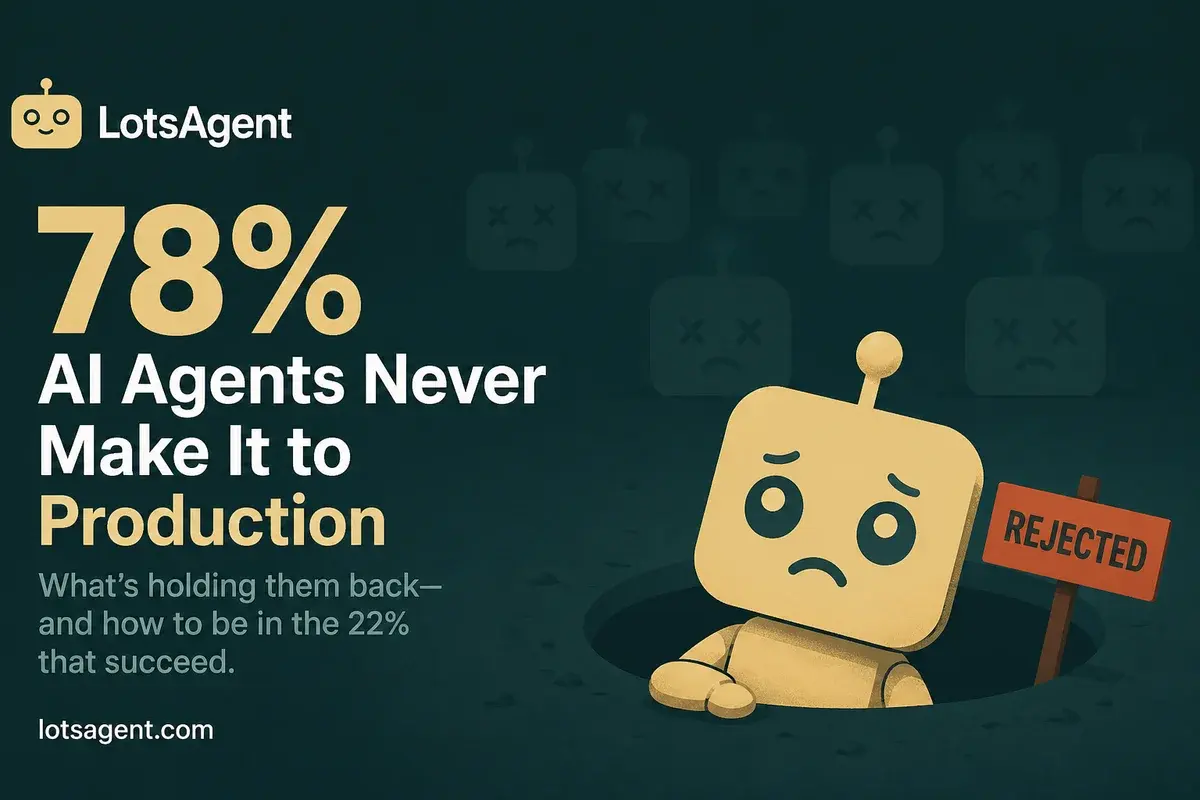
You spent six weeks on it. Wired it into Slack, connected your CRM, trained your team. On demo day, it worked beautifully.
Then it ran into a real scenario — a customer with an apostrophe in their name, an edge case your Zapier flow didn't account for — and silently broke. No error. No alert. It just stopped doing the thing it was supposed to do.
That story isn't rare. It's the statistical norm.
The Number Nobody Wants to Say Out Loud
According to Gartner's Q1 2026 enterprise survey, 78% of organizations have launched at least one AI agent pilot — but fewer than 15% have one reliably running in production. That means for every handful of teams with a working agent in the wild, dozens are stuck in demo-land, wondering what went wrong.
It's not a model problem. It's an architecture problem.
IDC's research, conducted in partnership with Lenovo, puts it more bluntly: of 33 AI agent prototypes it tracked, only 4 reached production successfully — an 88% pilot failure rate. For every company that shipped, two more wrote off the project.
The failure pattern shows up in Dynatrace's 2026 reliability report, which tested 6,259 production agents across 4.5 million executions. The findings: 89% gave incorrect answers at least once, and only 0.8% were fully healthy across every tracked dimension. Out of every 100 agents supposedly running in production, fewer than one is doing everything it should.
Gartner's 2026 forecast is equally uncomfortable: over 40% of agentic AI projects will be canceled by end of 2027 — not because the models failed, but because the infrastructure, data readiness, and integration layer fell apart under real conditions.
Why the Demo Works and Production Doesn't
You've probably already diagnosed this in your own shop. But it helps to name it precisely, because the fix depends on knowing exactly what's breaking.
1. It Schedules When You Tell It To — Not When It Needs To
Zapier and Make are trigger-based. They fire on an event or a schedule you define. But AI tasks don't always arrive on schedule. An agent that needs to follow up on a customer ticket can't just run at 9 AM — it needs to run after a ticket enters a certain state, after a human approves, after data is confirmed.
Tools built for rules don't handle that conditional logic well. You end up with a chain of five zaps, each one a potential failure point.
2. It Remembers Nothing From Yesterday
You asked it to prioritize your leads. Day one, it nailed it. Day two, it started from scratch — because it has no persistent memory.
This isn't a model problem. It's an infrastructure problem. Most in-house builds, and many low-code setups, don't wire in a memory layer at all. The agent runs, completes its context window, and forgets everything it learned. You're essentially re-explaining your business to it every single session.
If you're building an agent that needs to reason across workflows, AI agent memory is where most setups fall apart — not because memory is hard to add, but because it's rarely treated as a first-class requirement from the start.
3. The Integration Breaks and Nobody Notices
Dynatrace found that 30% of AI agent failures in production stem from integration layer failures — tools returning unexpected formats, token limits getting hit, or re-authentication loops triggering silently.
Zapier handles API calls, but it's not built for agents that need to reason across those calls. When a tool returns an unexpected response, Zapier either errors out or silently passes garbage downstream. You find out three days later when a customer flags a wrong invoice.
LangChain and custom Python builds give you full control — but full control means you own the heartbeat monitoring, the retry logic, the timeout handling, and the observability layer. For most teams, that's a second project bolted onto the first one.
If you've been fighting integration breakage with your agents, the fix isn't more careful prompts — it's better integration architecture.
4. It Hallucinates When the Context Gets Thin
Agents with poor context management make things up. Pull a partial lead list, and it'll infer the rest. Ask it to route a ticket, and it'll guess the priority.
Gartner's 2026 AI Trends report notes that 52% of enterprise AI deployments cite "insufficient data quality" as the top barrier to production — not the AI itself, but what the AI has to work with.
The demo has perfect data. Production has messy data. Your tooling has to account for that gap.
The Part Nobody Shows You in the Demo
Here's what the 0.8% of fully healthy agents have that the others don't:
They have durable execution. When something fails mid-task, the agent doesn't silently die — it checkpoints, pauses, and resumes. The work isn't lost. The state isn't corrupted. If you've wondered why your agent breaks every time there's a network hiccup, durable execution is the infrastructure answer.
They have persistent memory. The agent remembers your lead list, your routing rules, your team's preferences — across sessions, not just within one chat.
They have built-in error handling on tool calls. Not just "API returned error" — the agent knows what failed, why, and can retry or escalate accordingly.
They have visibility. You can see what the agent did, when, and why it made the decision it made.
That's not a feature list. That's a production stack.
How to Actually Get It to Production
The shift isn't about picking a better model. It's about choosing a platform that treats the agent as a production system from the start — not a prototype you hope survives contact with reality.
Here's what that looks like for an automation-aware operator who's already tried the alternatives:
Start with the failure modes, not the happy path. Before you build, write down: what happens when the CRM API is down? What happens when the lead list is empty? What happens when the output format changes?
Pick tooling that handles retries and checkpoints natively. You shouldn't be writing retry logic. Durable execution means the agent handles interruptions — network failures, context overflow, API timeouts — without manual intervention.
Wire in memory from day one, not as an afterthought. Persistent, vector-backed memory means your agent isn't learning your business from zero every morning.
Treat observability as non-negotiable. If you can't see what your agent decided and why, you can't trust it. Full execution logs and audit trails aren't an enterprise feature — they're the minimum for production.
Frequently Asked Questions
Why do most AI agent pilots fail to reach production?
Most AI agent pilots fail in production not because of weak AI models, but because of broken infrastructure underneath them. The three most common failure points are: the agent has no persistent memory (so it resets every session), the integration layer silently breaks when APIs return unexpected formats or tokens expire, and the agent has no checkpoint/retry system — so when anything fails mid-task, the work is simply lost.
According to Dynatrace's study of 6,259 production agents across 4.5 million executions, 89% gave incorrect answers at least once, and only 0.8% were fully healthy across all tracked dimensions. The failure isn't the exception — it's the statistical norm.
What is the difference between an AI agent pilot and production-ready AI?
An AI agent pilot runs in a controlled, ideal environment — clean data, predictable inputs, and someone watching it closely. A production-ready AI agent handles the opposite: messy data, unexpected formats, API failures, token limits, and conditional logic that can't be pre-scripted.
Production-ready agents also need durable execution (checkpointing so failures don't lose work), persistent memory (context across sessions), built-in error handling, and full observability. An agent without these is a prototype, not a product.
What does durable execution mean for AI agents?
Durable execution means an AI agent can pause, checkpoint its state, and resume exactly where it left off when something goes wrong — a network timeout, an API error, a token limit hit, or a process crash. Instead of silently dying or losing all progress, the agent preserves its work, handles the error, and continues.
This is fundamentally different from Zapier-style automation, which either completes a step or fails outright. Durable execution is the difference between an agent that can run unattended in production and one that needs constant babysitting.
Why do Zapier-based AI workflows fail in production?
Zapier and Make are trigger-based automation tools — they fire on a defined event or schedule. AI agents, by contrast, need to reason about whether and when to act based on context that changes constantly.
When these two paradigms meet, the mismatch creates three failure modes: conditional logic gets forced into rigid trigger chains (making them brittle), unexpected API responses pass silently downstream and corrupt data, and there's no memory across sessions — so the agent starts each run with no awareness of previous work.
Zapier is excellent for rules-based automation. It's not built for agents that need to reason.
How many AI agent projects get canceled?
According to Gartner's June 2025 prediction, over 40% of agentic AI projects will be canceled by end of 2027 — not because the underlying AI models failed, but because the infrastructure, data readiness, and integration layer weren't built to survive real-world conditions.
This aligns with what IDC found in its prototype study: of 33 AI agent pilots reviewed, only 4 successfully reached production — an 88% failure rate. The common thread in both cancellations and failures is infrastructure, not intelligence.
How do you make an AI agent production-ready?
Making an AI agent production-ready requires four things most in-house builds and low-code tools don't provide out of the box:
- Durable execution — so failures don't lose work
- Persistent memory — so the agent retains context across sessions
- Built-in error handling on tool calls — not just "API error," but retry logic, escalation paths, and fallback behavior
- Full observability — so you can audit what the agent did and why
Choosing a platform that ships all four of these from the start — rather than building them yourself — is the fastest path from pilot to production.
The Bottom Line
You've already seen this movie. The pilot works. The stakeholder demo impresses. Then production hits, the edge cases pile up, and the agent quietly stops being reliable.
The numbers confirm what most operators already know: the gap between "we have an AI agent strategy" and "we have an AI agent in production" is where most enterprise AI budgets disappear. Gartner's data shows the majority of organizations haven't crossed it yet.
The fix isn't a better prompt. It's a platform that was designed for production from the start.