 LotsAgent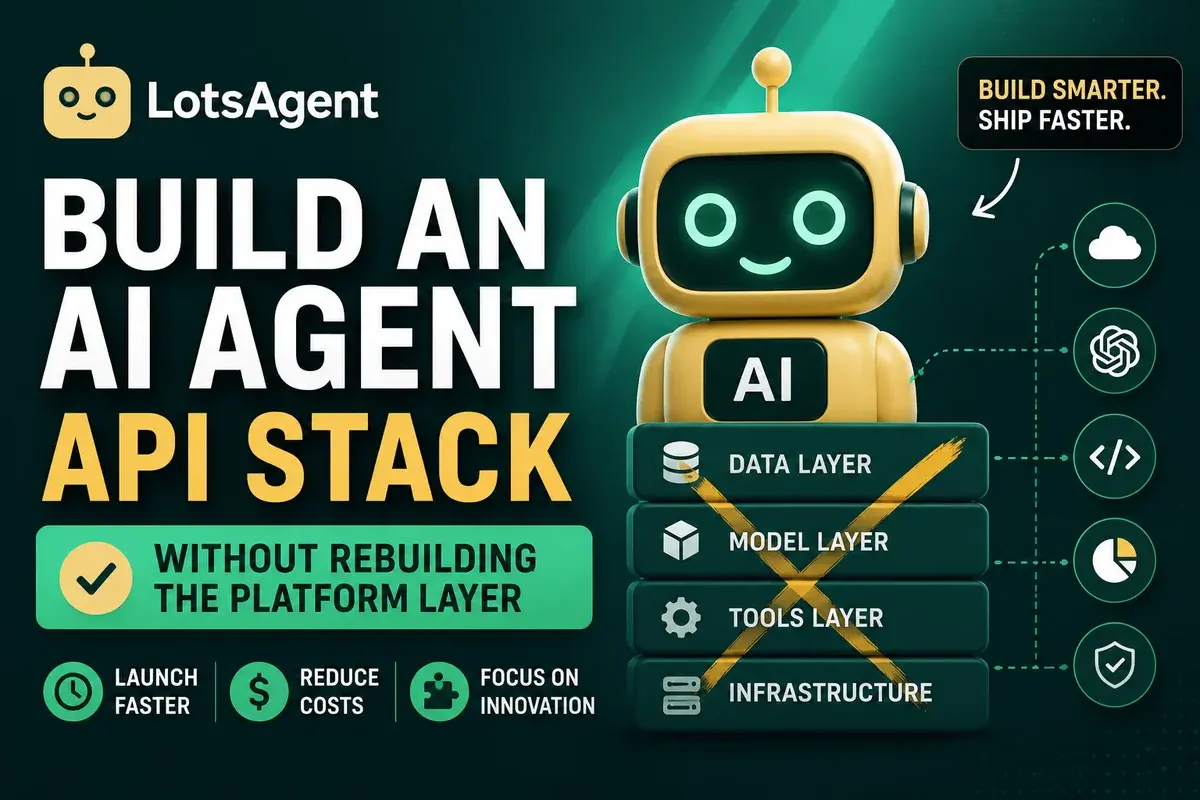
If you’re building an ai agent api, the model is usually the easy part. The hard part is everything the model depends on once real users start calling it: memory, tool access, durable execution, and human control.
That is the platform layer most teams end up rebuilding by accident. It starts as “just one workflow.” Then it becomes retries, logs, permissions, background jobs, tool schemas, state, and recovery when something fails halfway through.
This article breaks down the stack an agent API actually needs, what you have to own if you build it yourself, and where a platform like LotsAgent fits when you want to ship agent-powered features without rebuilding the runtime first.
What an AI Agent API Stack Actually Needs
An API for agents is not just a thin wrapper around a model endpoint. If the API is going to power real workflows, it needs five layers working together.
1. Agent creation and configuration
You need a stable definition for the agent itself: purpose, instructions, boundaries, and operating rules. That definition has to survive beyond a single prompt or request.
This is where agent platforms start to look different from plain LLM APIs. OpenAI’s Agents SDK docs call out that orchestration, tool execution, approvals, and state live in the application layer, not inside the model call itself.
2. Memory that survives individual requests
Agents do useful work when they remember what happened before. That can be user preferences, task state, prior approvals, or a workflow already in progress.
Without memory, every request starts cold. OpenAI’s memory reference treats persistence as a separate concern for exactly that reason.
If you want the deeper policy view on what to store and what to forget, What to Store, What to Forget, and How to Keep Control is the companion piece.
3. Tool access
An agent API has to do more than answer. It has to call tools: email, CRM, calendar, internal systems, webhooks, and custom APIs. If the agent cannot act in the systems your product depends on, it is just a chat layer.
The Model Context Protocol was created to standardize that tool connection layer. Anthropic describes MCP as an open standard for secure, two-way connections between data sources and AI-powered tools in its announcement, and the spec defines how servers expose tools for models to invoke.
For the wiring side, MCP Server for AI Agents: How Business Tools Become Agent-Callable shows why standardized tool exposure matters.
4. Durable execution
Real workflows fail halfway through. APIs timeout. A downstream service errors. A rate limit hits. A production-grade stack must checkpoint progress and resume from the last successful step instead of replaying the whole run.
That is the core promise of durable execution. Inngest’s durable execution docs describe functions that automatically retry from the point of failure, while its production guidance for agents frames durable execution as the missing reliability layer for AI agents in production.
If you want a deeper primer, What Durable Execution Actually Means for AI Agents covers the reliability layer in plain language.
5. Audit and control
If the agent is acting on behalf of a user, you need logs, approval boundaries, and visibility into what happened. Human control is not a nice-to-have. It is the trust layer.
That is the difference between a product feature and a liability.
What You Rebuild If You DIY the Stack
Most teams do not say, “We are rebuilding an AI agent platform.” They say, “We just need the API to run one workflow.” Then the list grows.
Here is what usually appears once the first version leaves the prototype stage.
Memory infrastructure
You need storage for state, context, and preferences. You also need rules for retention, refresh, and deletion. If memory is wrong or stale, the agent becomes unreliable.
Tool orchestration
Every tool needs auth, error handling, schema management, and retry logic. One tool is manageable. Five tools are not. Once your agent has to use multiple systems in a single run, the orchestration problem becomes the product.
Execution management
A simple request/response model is not enough. You need durable workflows, progress checkpoints, recovery after failure, and a way to know where the agent is in the run.
Observability
You need run logs, timestamps, input/output traces, and a way to inspect what happened when something goes wrong. If you cannot explain an agent run after the fact, you do not have a production system.
Control boundaries
You need rules for what the agent can do automatically and what needs review. That includes sensitive actions, customer-facing actions, and anything irreversible.
The issue is not that any one of these is impossible. The issue is that they are separate systems. Rebuilding all of them takes time away from the product you actually want to ship.
Where LotsAgent Fits
LotsAgent exists to remove the platform layer from the stack so you can focus on the product layer.
If your goal is to expose agent capabilities through an API, LotsAgent gives you the pieces that are usually most painful to rebuild:
- persistent memory
- tool access across real systems
- durable execution
- auditability and control
- multi-channel deployment from the same setup
That matters because most API-first agent products do not fail on model quality. They fail on the operational layer around the model.
If you want the broader product-view of this decision, AI Agent API: How to Give Customers Agents Without Building Agent Infrastructure is the companion piece. This article goes one level deeper into the stack decision itself.
The Build-vs-Buy Decision
The real decision is not whether you can build the platform layer.
You can.
The real question is whether that is the best use of your team.
Build it yourself when:
- the platform layer is your product
- you need custom behavior that no existing platform can support
- you have the engineering capacity to own memory, tools, retries, logs, and control for the long term
Use an agent platform when:
- the agent is part of your product, not the product itself
- you want to ship faster
- you need a reliable foundation before customers depend on the workflow
- you want to spend engineering time on domain logic, not orchestration scaffolding
For most teams, the first path looks exciting and the second path looks boring. In practice, boring is often what ships.
A Practical AI Agent API Stack for Builders
Here is a simple way to think about the stack.
API layer
This is the surface your product exposes. Customers call it, your application receives the request, and the agent run begins.
Agent layer
This is the reasoning and decision-making layer. The agent interprets the request, uses instructions, and decides what to do.
Memory layer
This stores the context that should carry across runs. Without it, every interaction becomes a first interaction.
Tool layer
This is where the agent reaches into Gmail, CRM, calendars, databases, webhooks, or internal systems.
Execution layer
This keeps the workflow alive through failures and interruptions.
Control layer
This keeps humans in charge of the boundaries.
That stack is easier to describe than to build.
Real Workflow Examples
Customer support automation
A customer submits a request through your product API. The agent checks the account, reads the issue, drafts a response, and flags anything sensitive for review. The user sees the result, but your team never had to build the execution engine underneath.
CRM follow-up
A lead comes in through your product. The agent looks up the contact, checks prior activity, drafts a follow-up, and logs the interaction. The API call looks simple. The work behind it is not.
Internal operations
A team uses your app to trigger an agent that checks multiple systems, compiles context, and routes a task to the right person. The agent needs memory, tools, and checkpointing. A single endpoint is not enough.
Productized agent features
You want to sell agent actions inside your SaaS product without becoming an infrastructure company. That is exactly where an agent platform helps. You own the experience. The platform owns the runtime.
What LotsAgent Removes From Your Roadmap
If you try to build the platform layer yourself, you are signing up for:
- memory storage and retrieval
- tool connection logic
- retry handling and durable workflows
- audit logs and run histories
- permission boundaries
- deployment surfaces across channels
LotsAgent removes that layer so your team can focus on the workflow that matters.
That does not mean there is no work left. You still need to design the business logic, the user experience, and the safe boundaries for the agent. But you are no longer rebuilding the base system every time you add a capability.
The Real Advantage of Not Rebuilding
The biggest benefit is not speed, although speed matters.
It is focus.
When the platform layer is already there, you stop spending time on plumbing and start spending time on the actual use case:
- better routing
- better decisions
- better product workflows
- better user outcomes
That is the part your customers will feel.
A Simple Rule for Builders
If your product needs one or two agent flows and those flows have real users, do not start by building the entire platform layer.
Start with the workflow.
If the workflow proves value, then decide whether platform ownership is actually your moat. Most teams discover it is not.
FAQ
What does an AI agent API stack include?
At minimum: the API surface, agent configuration, memory, tool access, durable execution, and control boundaries. If any of those are missing, the stack is incomplete.
Why not just call a model directly?
A model call can generate text. It cannot, by itself, manage long-lived state, call tools reliably, resume failed runs, or enforce human control. That is why the platform layer exists.
When should I build the platform layer myself?
Only when the platform layer is the thing you are selling, or when your requirements are so specific that a platform cannot support them. Otherwise, building it usually slows down the product.
How does LotsAgent help with agent APIs?
LotsAgent provides the runtime pieces most teams do not want to rebuild: memory, tools, execution, and control. That lets you focus on the workflow and the product experience.
What is the safest way to start?
Start with one narrow workflow, define the human review boundary, connect only the tools that are required, and validate the output before you expand scope.
Final Take
An ai agent api is only useful when the stack around it is real. That means memory, tools, durable execution, and control. If you rebuild all of that from scratch, you are no longer just shipping an agent feature. You are shipping infrastructure.
LotsAgent gives you the platform layer so you can ship the product layer faster.
Read the API docs or create your first agent free.