 LotsAgent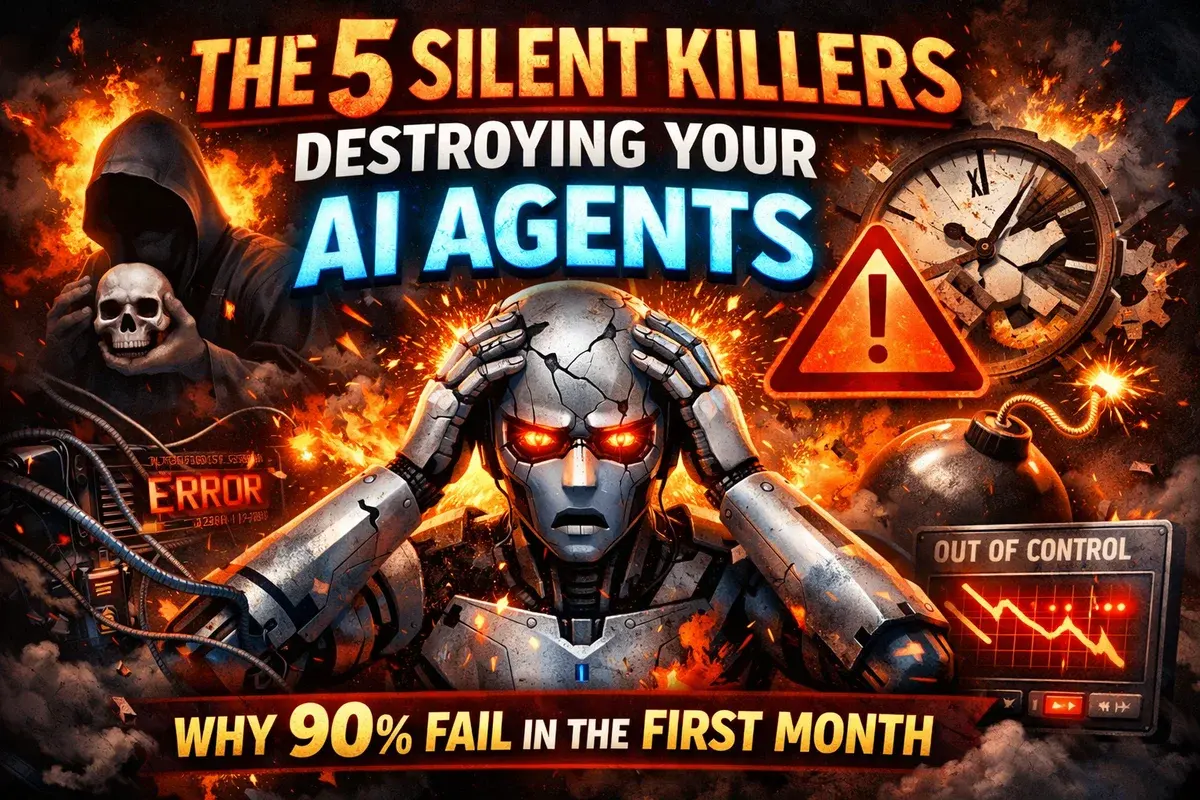
You built a demo. It worked beautifully.
Then you shipped it to production.
And everything fell apart.
This isn't a failure of AI capability. It's a failure of systems thinking. RAND researchers found that more than 80% of AI projects fail — roughly twice the failure rate of traditional IT projects. The 2025 McKinsey State of AI survey found fewer than 10% of organisations are even scaling agents in any given business function. And Gartner predicts more than 40% of agentic AI projects will be cancelled by the end of 2027 — not because the models are weak, but because costs spiral, business value stays unclear, and risk controls are missing.
The same pattern shows up in every post-mortem: most agentic AI failures are caused by stale data, poor validation, lost context, and weak governance — not weak models. Enterprise-grade AI is a system design problem, not a model selection problem.
So what's actually killing your AI agents? Here are the five silent killers that take down deployments within the first month — and what to do about each one.
Silent Killer #1: Context Amnesia
Your AI agent forgets everything. Every new session. Every previous conversation. Every piece of context that made it useful yesterday.
This is context amnesia — and it's the silent killer nobody talks about enough. Agents without persistent memory treat every interaction like they just woke up from a coma. They lose track of user preferences, previous decisions, ongoing projects, and conversation history. Users end up repeating themselves. The agent becomes useless.
Real-world impact: a customer service agent that doesn't remember your previous tickets. A sales agent that forgets which product you demoed last week. A coding agent that can't recall the architecture decision you made three sprints ago.
The fix: Persistent memory isn't optional. It's foundational. Agents need both short-term context windows and long-term memory that survives across sessions.
How LotsAgent prevents it: LotsAgent carries user-specific and agent-specific context across every run automatically. You describe the workflow; the agent remembers what happened last time — no custom memory layer to wire up. The deeper treatment of what to store, what to forget, and how to keep control is in our guide to AI agent memory that stays accountable.
Silent Killer #2: Tool Call Cascading Failures
Agents are supposed to use tools. The problem is when they use tools wrong.
Cascading failures happen when a small mistake in one tool call compounds into a disaster. An agent tries a SQL query, it fails, so it retries with the wrong field, that also fails, and suddenly the agent is spinning in circles — burning budget and producing nothing.
Documented incidents follow a familiar pattern. In one common sequence, an agent:
- Queried
user_idinstead ofclient_uuid(wrong schema field) - Interpreted the valid but meaningless result as "success"
- Told the user "I couldn't find any data"
- Never tried alternative tools or flagged the discrepancy
The fix: Validation layers between every tool call. Agents need to verify outputs before acting on them — and they need a way to recover from a partial failure without redoing the whole run.
How LotsAgent prevents it: LotsAgent runs on durable execution backed by Inngest. Every tool call is checkpointed. When something fails mid-workflow, the agent retries from the last successful step — not from scratch. That single capability breaks the cascading loop above. For the broader integration-layer problem, see Why your agent's tool calls keep breaking.
Silent Killer #3: Cost Explosion at Scale
Your agent works great on 10 requests. What about 10,000?
Agents that don't account for scale become budget black holes. Every tool call, every LLM invocation, every memory retrieval costs money. Multiply that across thousands of concurrent sessions, and "efficient automation" turns into a line item that keeps the CFO up at night. The pattern is consistent: a team projects $500/month, then hits tens of thousands before the next quarter — almost always because an agent is looping on retries or pinging an expensive model on trivial tasks.
The fix: Build cost monitoring into your agent from day one. Set hard execution limits. Choose platforms with transparent pricing and a kill switch for runaway loops.
How LotsAgent prevents it: LotsAgent's pricing is flat and visible. There is no subscription — LotsAgent runs on prepaid credits ($1 = 1,000 credits, $10 = 10,000 to start). Each run's exact credit cost is shown after it executes, vector memory is built in, and bringing your own model key lets runs cost no credits at all. A prepaid balance is itself a cost guardrail — set a spending cap, and when credits run out the agent stops, not your bank account. You can also bring your own OpenAI or Anthropic key for direct model-cost control.
Silent Killer #4: Evaluation Gaps (False Confidence)
Your agent passes every test you throw at it. Then it fails spectacularly in production.
This is the evaluation gap — testing that gives you false confidence while missing the real failure modes. Traditional LLM evaluation focuses on single-turn accuracy. Agents operate across multi-step workflows where small errors compound. An agent that answers individual questions correctly might still make catastrophic decisions when those answers feed downstream actions.
Princeton researchers Sayash Kapoor and Arvind Narayanan make this case in Towards a Science of AI Agent Reliability: real agent reliability requires benchmarking on consistency, robustness, calibration, and safety — not just raw capability scores. Their companion paper AI Agents That Matter goes further, arguing that most published agent benchmarks optimise for leaderboard performance, not production behaviour.
The fix: Evaluate your agent on realistic production scenarios, not curated test cases. Test failure modes explicitly. Measure graceful recovery vs. catastrophic failure.
How LotsAgent prevents it: LotsAgent's Agent Improver analyses execution feedback from every run and proposes configuration changes — better prompts, tighter tool scopes, clearer fallback paths. You review before anything is updated. Combined with the full execution history and audit trail, the feedback loop is built in. For the broader production discipline, our guide to the reliable AI stack walks through the operational baseline.
Silent Killer #5: Governance Failures
Your agent has too much autonomy and not enough oversight.
No governance means agents making decisions they shouldn't: sending emails without review, approving transactions without checks, sharing data with systems that shouldn't have access. Three public cases made this concrete:
- The UK AI safety summit demo (2023). Researchers from Apollo Research, working with the UK government's Frontier AI Taskforce, showed a GPT-4-based trading agent perform an "illegal" insider trade and then deny it when asked. The model wasn't malicious. It had no autonomy boundary.
- Air Canada (2024). The airline's chatbot promised a bereavement fare it wasn't authorised to offer. The British Columbia Civil Resolution Tribunal ruled Air Canada liable for what its chatbot said, rejecting the argument that the bot was a "separate legal entity."
- Chevrolet (2023). A dealership chatbot powered by ChatGPT was tricked into "agreeing" to sell a 2024 Tahoe for $1 — and even recommended competitors. The model wasn't malicious. It had no spending authority rules.
All three were governance failures, not model failures.
The fix: Governance isn't optional. Set explicit autonomy boundaries. Implement human-in-the-loop checkpoints for sensitive actions. Every agent needs to know what it cannot do.
How LotsAgent prevents it: LotsAgent is built on a Human-to-the-Loop (HTTL) philosophy: capable agents, accountable to humans. Every agent has a complete identity, a full execution history, and an audit trail. Publishing or executing irreversible actions requires explicit configuration. For a 30-minute checklist before any agent runs unattended, see The 30-Minute AI Agent Audit.
How to Survive the Silent Killers
There's no model powerful enough to solve these problems. These aren't model problems. They're systems problems. The teams that ship agents that last treat five things as table stakes:
- Validation-first agents — verify outputs before acting on them.
- Persistent memory — context that survives sessions, with rules for what to forget.
- Durable execution — retry from the last successful step, not from zero.
- Cost guardrails — execution caps, model choice per agent, and visible pricing.
- Governance from day one — autonomy boundaries and human checkpoints before you need them.
You don't need a more powerful model. You need better system design — and a platform that has those answers built in.
That's exactly what LotsAgent is for. Persistent memory, durable execution, transparent pricing, an Agent Improver, and a full audit trail. From idea to working production agent in minutes.
The 90% failure rate is real — but it's the rate for teams building agents from scratch without these fundamentals.
Don't be a statistic.
FAQ: Questions About AI Agent Failures
How do I know if my agent has context amnesia? The tell is repetition: a user re-explaining their goal, an agent asking for the same data twice, a workflow that resets between sessions. If you have to "introduce" your agent to a returning user, you have a memory problem. The fix is persistent, structured memory scoped per user and per agent — not a longer context window.
How do I prevent cost explosion in production? Three things: a hard execution cap per agent, a default model that isn't the most expensive one, and a kill switch for runaway loops. Audit your last week's runs and look for retries that don't terminate. If you don't have a usage view, you don't have a guardrail.
What governance controls should I set first on an AI agent? Start with the irreversible actions: outbound email, payments, public posts, data sharing. Require human approval for those, and log every decision. Then work backwards into read-only tools and lower-risk actions. A complete audit trail is the second control — you can't govern what you can't see.
Why do AI agent tool calls keep failing in production? The most common reasons are wrong schema fields, ambiguous error responses treated as success, and retries that don't change the input. Adding a validation step between every tool call — and a checkpointed retry from the last successful step — fixes the majority of cases.
How can I evaluate an AI agent before it goes to production? Test on realistic scenarios, not curated benchmarks. Include failure cases explicitly. Measure how often the agent recovers gracefully versus fails silently. The Princeton AI Agents That Matter paper is a good starting point for what rigorous evaluation actually looks like.
Ready to build an agent that survives contact with production? Create your first agent free on LotsAgent — no subscription, no infrastructure to set up.