 LotsAgent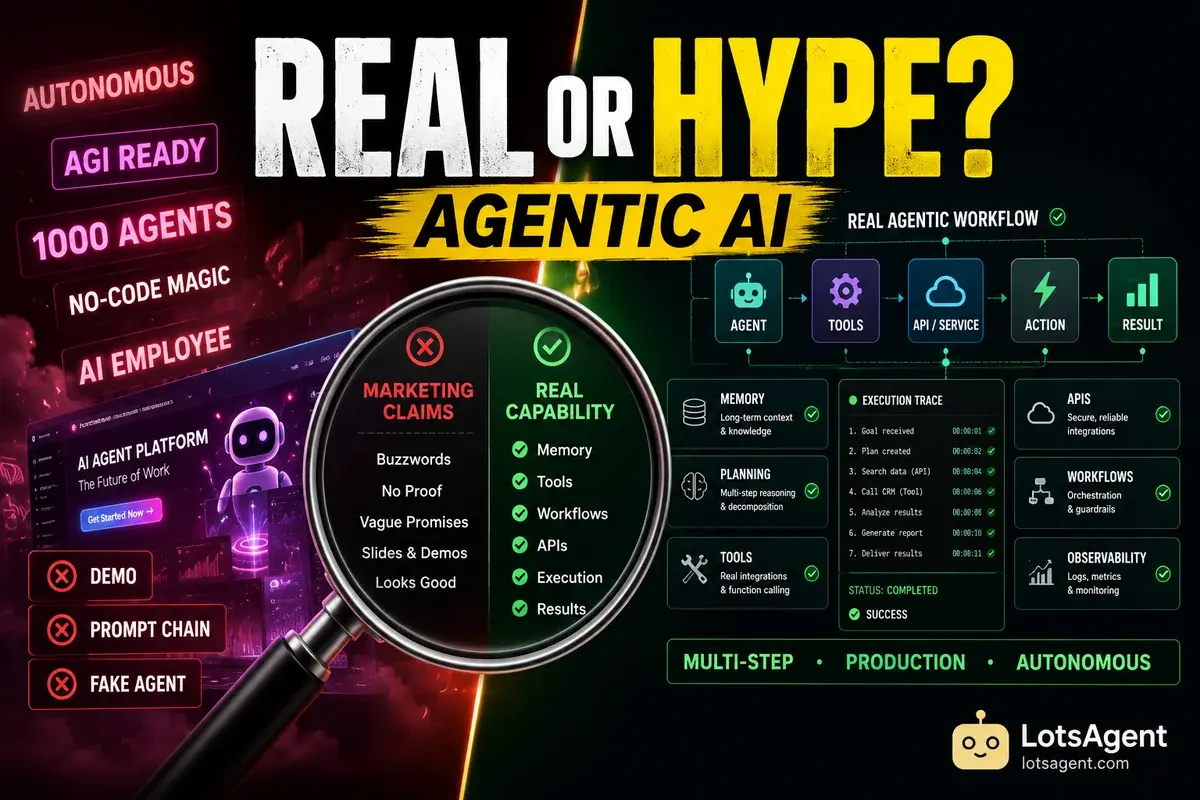
Every major vendor in 2026 has rebranded as an "agentic AI platform." Microsoft Copilot Studio. Salesforce Agentforce. AWS Bedrock Agents. Google Vertex AI Agents. ServiceNow, Oracle, SAP, Workday — all of them. The label is on every landing page, every analyst report, every comparison chart.
If you are a buyer trying to pick one, you have a problem. The marketing is the same on all of them. "Agents that reason." "Agents that remember." "Agents that act." None of it is wrong. None of it tells you which platform will actually do the work after the demo ends.
This post is a buyer-side framework for cutting through the noise. Four scenarios you can run in a 30-minute trial. Four marketing patterns to recognize. Five red flags that mean "this is a chatbot or workflow tool with agent branding." By the end, you will have a shortlist method that does not depend on vendor copy.
Four marketing patterns have polluted the term "agentic AI platform" in 2026
The first job is to sort vendors into one of four buckets. The first three are not real agentic platforms. The fourth is what you actually want.
-
AI assistant with a tool icon. Still a chat surface. Single-turn reasoning. No persistent memory between sessions. No execution. You have used this — it is a Claude or ChatGPT window with a "use tool" toggle.
-
Workflow tool with an LLM in the loop. Next-generation Zapier or Make. The agent can branch based on model output, but the underlying logic is still "if this then that." It still cannot reason across unstructured input or carry context across runs. It looks agentic. It is not.
-
SDK with marketing copy. A developer framework like LangGraph, CrewAI, or the Claude Agent SDK. Powerful, flexible, code-first. Forces you to wire up memory, tools, durable execution, deployment channels, audit trails, retries — all of it. You are buying a building kit, not a platform.
-
Real agentic platform. Memory that compounds. Tools across the stack. Durable execution that survives failures. Multi-channel deployment from one configuration. Audit trail on every action. Human review steps on irreversible work. This is the category — and the gap between this and the first three is the gap between a working agent and a slide.
The buyer task in 2026 is to figure out which bucket a vendor actually lives in. Demos do not tell you. The four-scenario test plan does.
What an agentic platform is in 2026, in three properties
Most "agentic AI platform" pages use the word "agent" loosely. The actual definition tightens to three properties that all have to be present:
- Reasoning over rules. The agent decides what to do next based on the current state of the work, not a pre-written branch tree. If your workflow can be drawn as a flowchart with no decision nodes, you do not have an agent.
- Memory that compounds. The agent remembers across runs. It does not start fresh every time. It can recall what it learned about a customer, a project, a recurring workflow — and use that to make the next call better.
- Tools across the stack. The agent takes real action in the systems you already use. Gmail, Slack, GitHub, your CRM, your database, your ticketing system. Not a sandbox. Your actual stack.
These are the same three properties that distinguish an agentic workflow from a task and a durable execution flow from a one-shot script. If a platform does not have all three, it is one of the first three buckets above.
The 4-scenario test plan: what real capability looks like vs what marketing looks like
You can run this in any vendor trial. Thirty minutes per scenario. A real platform passes all four. A marketing-grade platform fails at least one.
Scenario 1: Memory durability under failure
Pick a workflow that needs context. A lead qualification flow. A support ticket triage. A weekly report draft. Run the agent twice on the same input, but kill the underlying model connection mid-execution the second time. The first run should complete. The second run should resume from the last checkpoint with all prior context intact — the customer's name, the stage of qualification, the partial draft. The agent should not ask you to start over. It should pick up exactly where it left off, with the same memory state.
Real capability: the agent restores memory and resumes state from the last successful step. Marketing: the agent restarts. You get a "looks like something went wrong, want to start over?" message. Memory is session-only, or worse, request-only.
Scenario 2: Tool failure recovery
Take the same workflow. Disconnect a tool mid-run — revoke the Gmail token, or break the Slack webhook, or simulate a database timeout on one of the steps. Watch what happens.
Real capability: the agent catches the tool failure, logs it, retries from the last successful checkpoint, and either completes or surfaces a clean handoff back to you with the partial state preserved. This is what durable execution actually buys you. The workflow does not restart from step one. Marketing: the entire workflow fails. The agent loses all the steps it already completed. You have to rerun it. Or worse, the failure is silent — the agent reports success while the email or the CRM update quietly never happened.
Scenario 3: Review-step enforcement
Give the agent a real irreversible action. Send an email to a customer. Update a CRM record. Post to a Slack channel. Charge a card. Now try to send that action through without human approval.
Real capability: the agent stops at the review gate. The action is queued, not executed. You see exactly what it intends to send, the context it used to decide, and a clear approve or edit button. The agent waits. It does not time out and send anyway. It does not have a "skip review for trusted senders" toggle that is on by default. Marketing: the agent sends first and notifies you after. Or the review step is cosmetic — a banner that says "this message will be sent in 5 seconds" with no stop button that actually works under load. Run this twice. If either run goes through without you clicking approve, the review step is theatre.
Scenario 4: Audit trail completeness
Run the agent on a real workflow. Then open the log.
Real capability: every tool call has a timestamp, the input, the output, and the model reasoning that produced it. Every review checkpoint is recorded with who approved and when. Every failure has the retry history. Every decision branch has the model output that triggered it. The log is exportable. You can hand it to a security reviewer or a customer and answer "what did your agent do and why" with a single document. Marketing: the log shows "task started" and "task completed." Maybe a couple of intermediate steps. The tool call bodies are redacted. The reasoning traces are not stored. Failures are summarized in a single line. This is the audit trail gap that EU AI Act Article 12 was written to close, and most 2026 platforms are not ready for it.
Before and after: the same email workflow, two different platforms
The clearest way to see the gap is to run the same workflow on a marketing-grade platform and a real one. Here is a lead-qualification example — the same flow the email decision-and-followup post walks through.
Marketing demo. You connect Gmail. The vendor shows a slide: "our agent reads incoming leads, drafts a reply, and routes it to a human for review." The live demo is a string. The agent says "I read the email, the lead is qualified, here is a draft reply." You click "approve" and a reply goes out. Behind the scenes, the agent checked nothing. It did not look at your CRM. It did not enrich the lead. It did not check the lead against your ICP. It did not log the reasoning. You approved a hallucination dressed up as a workflow.
Real agentic platform. You set up the agent once. It connects to Gmail, your CRM, your knowledge base, and Telegram. When a new lead arrives, the agent reads the email, pulls the lead's CRM record, qualifies against the ICP skill you configured, drafts a reply using the tone-of-voice skill you trained, and routes the draft to your Telegram for review — with the full context inline. You see the email it read, the CRM data it pulled, the qualification score, and the draft. You approve. The reply goes out. The agent logs every step with timestamps and tool responses. If any step fails, the agent retries from the last checkpoint, not from the beginning. The next lead arrives two hours later. The agent remembers what it learned from the last one. Same workflow. Same audit trail. Same review gate.
The difference is not a feature list. It is whether the platform gives you a working audit trail of a real decision, or a chat window that says it did the work.
Where LotsAgent sits in the four buckets
LotsAgent is in the fourth bucket. The capability stack is what makes that claim specific, not marketing language:
- Durable execution. Every agent run is checkpointed. If a tool call fails or the model drops, the agent resumes from the last step with full state intact. No re-running the workflow. No lost steps.
- Persistent memory. Agents remember across runs — both text and vector memory are built in. Memory is user-specific and agent-specific. It compounds.
- 100+ tool integrations. Gmail, Slack, GitHub, Google Calendar, Google Drive, your CRM, your database — connected through a unified tool layer, not hand-wired one by one.
- Multi-channel deployment from one configuration. The same agent runs on web, email, Telegram, API, MCP, and webhooks. Build once. Deploy everywhere.
- Review steps on irreversible actions. You configure the review gate. The agent cannot send the email, update the record, or trigger the action until a human approves. This is configurable, not cosmetic.
- Full audit trail. Every tool call, every decision, every review checkpoint, every retry — logged. Exportable. Answerable to a security reviewer, a customer, or your future self.
- Agent Skills. Reusable knowledge and workflow modules. Train the agent on your tone of voice once, your ICP once, your escalation rules once. Apply them across workflows.
- Agent Improver. The agent analyses its own execution feedback and proposes configuration improvements. You review and approve before anything changes. It is a feedback loop you control.
The HTTL line — capable agents, accountable to humans — is the trust signal that separates a real agentic platform from a marketing claim. LotsAgent does not claim full autonomy. The platform is built around the fact that you should always know what your agent did, when, and why. That boundary is the feature.
The point is not "use LotsAgent." The point is that an agentic AI platform is supposed to pass all four scenarios by default. Most do not. A buyer who runs these four tests in a 30-minute trial will sort real platforms from rebranded chatbots faster than any comparison chart.
The 5 red flags that mean it is not a real agentic platform
If you see any of these, the vendor is in one of the first three buckets, not the fourth. Walk away.
- No persistent memory between runs. The agent forgets everything the moment the conversation ends. Every workflow starts from zero. This is the single biggest tell. A platform that cannot remember yesterday's customer cannot compound.
- No durable execution. Every failure restarts the workflow from step one. The agent has no concept of "last successful checkpoint." Long workflows are unusable in production because one bad API call wipes the run.
- No enforced review step on irreversible actions. The agent sends, posts, or charges before you approve. The review gate is cosmetic, configurable to off by default, or missing entirely. This is the HTTL line. A platform that crosses it without asking is not an agentic platform. It is a liability.
- No audit trail. The log shows task start and task end. Tool calls are redacted. Reasoning is not stored. Failures are summarized in one line. You cannot answer "what did the agent do, and why" with a document. Run the 30-minute audit on any platform before you sign.
- No multi-channel deployment from the same agent. The agent works in a web UI. To get it onto email, you wire up a separate integration. To get it on Telegram, another. To expose it via API, another. The "platform" is actually five different products loosely tied together.
Any single red flag is enough to disqualify. Most marketing-grade platforms have three or four.
What to do next
If you are evaluating agentic AI platforms in 2026, you do not need another comparison chart. You need to run the four scenarios.
Pick a real workflow. Run each scenario on a 30-minute trial. Check the log. Check the review gate. Check what happens when a tool dies. The platform that passes all four is the platform you should be talking to.
LotsAgent passes all four by default. Memory, durable execution, review steps, audit trail, MCP-enabled tool access, multi-channel deployment — built in, not a roadmap item. You can create your first agent free and run the four scenarios yourself in under an hour.
The buyers who will win in 2026 are the ones who stopped trusting the marketing and started running the tests.
FAQ
How do I verify memory durability in a trial? Run the same workflow twice. Kill the underlying model connection mid-execution on the second run. A real platform resumes from the last checkpoint with full context. A marketing platform asks you to start over, or silently restarts.
How do I confirm a review step is enforced, not cosmetic? Give the agent an irreversible action — sending an email, updating a record, charging a card. Try to trigger it without approving. Run it twice. If either run executes without your explicit click, the review gate is theatre.
What is the difference between an agentic platform and an agent SDK? An SDK is a developer framework. You wire up memory, tools, deployment channels, durable execution, retries, and audit trails yourself. An agentic platform provides all of those built in, deployable without engineering work. SDKs are powerful and flexible. They are not platforms.
Why does MCP support matter for an agentic platform? MCP — the Model Context Protocol — is how an agent calls external tools in a standard way. Without MCP, every tool integration is hand-wired. With it, the platform can connect to a growing ecosystem of business tools without per-tool engineering. It is the difference between a closed garden and a working tool layer.
What does "durable execution" actually mean in a trial? Take any multi-step workflow. Disconnect a tool mid-run. A real durable execution engine catches the failure, logs it, and resumes from the last successful step with state intact. A marketing-grade platform restarts the workflow from step one. You can read the technical breakdown in the durable execution post.
What should an agentic platform never do without human review? Any irreversible action that affects a customer, a record, or a payment. Sending external messages. Updating production data. Triggering downstream systems. Posting publicly. The review gate is not optional — it is the HTTL boundary that separates capable agents from accountable agents.