 LotsAgent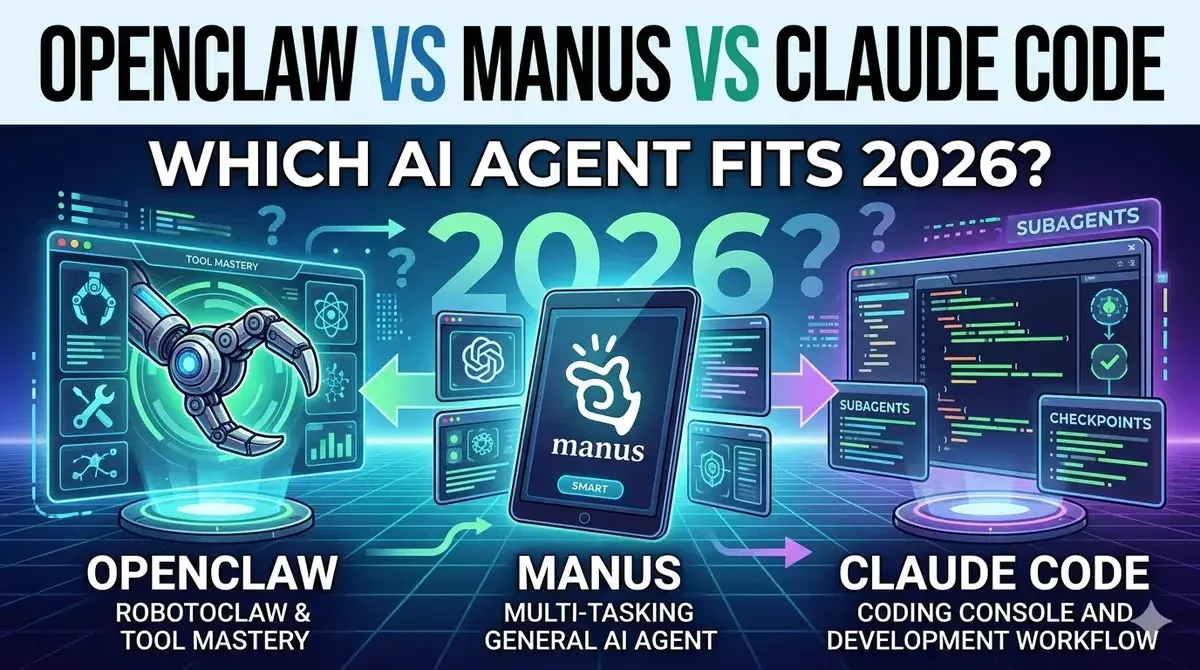
AI agents aren't science experiments anymore.
They're shipping code. Running multi-step workflows. Acting like junior employees that never sleep, never call in sick, and can be replicated for almost nothing.
The landscape in early 2026 looks nothing like it did a year ago. OpenClaw blew past 350,000 GitHub stars in under five months. Meta bought Manus for over $2 billion — their third-largest acquisition ever. Anthropic shipped over 30 new Claude Code features in Q1 2026 alone.
If you're trying to pick between OpenClaw, Manus, and Claude Code for your team, you need more than a feature list. You need a framework for deciding which one actually solves your problem — and what to do when none of them do it alone.
This post cuts through the hype. It's built for operators, founders, and builders who want a real comparison, not a vendor brochure.
The comparison that matters: philosophy, not features
There is no "best" agent. That's not a cop-out — it's the honest answer.
Each of these tools is built around a completely different mental model:
- OpenClaw gives you total control — and total responsibility for everything from security to scaling
- Manus gives you speed and zero infrastructure — at the cost of vendor dependency
- Claude Code gives you a coding partner that lives inside your existing dev environment
Instead of asking "which is best?", ask: "What kind of team am I, and what problems do I actually need solved?"
The answer determines which tool — or combination of tools — actually serves you.
OpenClaw: When you need power and can handle the weight
OpenClaw launched in late 2025 under a few names (Clawdbot, then Moltbot) before settling on OpenClaw. In roughly ten weeks it crossed 150,000 GitHub stars. By early 2026, that number was well over 350,000 — faster than React, faster than almost anything in open source history.
That growth signals real demand. So what is it?
OpenClaw is a self-hosted AI agent runtime. You run it. You wire it. You secure it. You own the infrastructure.
It integrates with Slack, WhatsApp, Telegram, internal APIs, and whatever else you need to connect. The agent has identity, memory, and tool access — and you're in charge of all of it.
This is the model that teams like NASA's ops team and autonomous vehicle developers are building on. It's the agent platform when you're treating AI as production infrastructure, not an experiment.
The real risk nobody talks about
Self-hosted means you own the risk too. And 2026 made that concrete.
OpenClaw has had multiple critical CVEs — including CVE-2026-25253 (CVSS 8.8, one-click RCE) and CVE-2026-25593 — plus a privilege escalation flaw that allowed admin-level remote code execution.
OpenClaw's team has patched these quickly. But with self-hosted agents, you decide when to update. You own the patching cadence. You own the monitoring.
For some teams, that's a feature. For others, it's a full-time job they didn't budget for.
What the comparison misses — and why it matters
Here's what OpenClaw, Manus, and Claude Code all have in common: none of them give you a complete team agent out of the box.
A real team agent needs:
- An email address it can receive and respond from
- A presence in Slack or Telegram
- Persistent memory of clients, projects, and preferences
- A human-in-the-loop review step before it does something irreversible
None of these three tools are built natively for that. With OpenClaw, you have to wire that layer yourself. With Manus, it's task-focused, not persona-driven. With Claude Code, it's stuck inside your IDE.
That's the gap — and it's exactly what an agent platform like LotsAgent is built to close. You get the same agent infrastructure that powers LotsBlog and the broader LotsTech ecosystem: identity, memory, multi-channel access, and durable execution — without building it from scratch.
Who should use OpenClaw
- Teams with strong DevOps culture who treat AI agents as production systems
- Companies with strict data sovereignty requirements — nothing leaves your infra
- Organizations that want to evaluate and improve agents internally before going cloud-native
If you have the security expertise and the team to support it, OpenClaw gives you something the others can't: full visibility into every execution, every decision, every failure.
If you don't have that team? This will feel like owning a race car in a city with no mechanics.
Manus: Speed and convenience with real trade-offs
Manus is the opposite philosophy. No infra headaches. No setup drama. Log in, describe what you need, and the agent handles the rest.
It handles multi-step workflows, document processing, code generation, and web tasks. Meta acquired Manus in December 2025 — reportedly paying over $2 billion in their third-largest deal ever. China subsequently ordered Meta to unwind the acquisition, which means the situation is legally unresolved as of mid-2026 — a real factor if you're building on Manus long-term.
Manus confirmed the acquisition on their official blog, saying they'll continue delivering current services while accelerating product improvements. Whether that holds through the regulatory process is a question worth tracking.
Why operators pick Manus
The speed is real. You can have a useful workflow running in hours instead of weeks. The cloud-native model means no servers to manage, no patches to apply, no monitoring to configure.
For startups and lean teams moving fast, that's a massive advantage.
The trade-off you need to understand
You're building on someone else's infrastructure. Your data flows through systems you don't control. Your agent logic isn't fully transparent. You're subject to vendor decisions — pricing changes, feature deprecations, regulatory shifts.
Right now, the China situation adds a layer of uncertainty: if the acquisition gets unwound, what happens to Manus's services and your integrations? This isn't a reason to avoid Manus — it's a reason to architect with contingencies, like any vendor dependency.
Who should use Manus
- Teams that want results fast and don't want to touch infrastructure
- Startups running lean operations that need working agents now, not in Q3
- Operators who are okay with SaaS governance and vendor dependency
If you're optimizing for speed to value, Manus is the pick. If you're optimizing for long-term control and data sovereignty, look elsewhere.
Claude Code: The coding partner that ships
Claude Code is built differently. It's not trying to be everything. It's relentlessly focused on one thing: helping developers ship code faster.
It lives where developers live — terminal, VS Code, Cursor, your actual codebase. It doesn't just suggest code. It reads files, refactors systems, runs commands, and works with you through the entire development cycle.
Anthropic shipped over 30 new features in Q1 2026 alone, including new model capabilities, integrations, and tools. The March 2026 update introduced more autonomous execution modes — Anthropic's new auto mode lets Claude execute tasks with fewer approval prompts, while keeping humans in the loop on high-stakes actions.
This matters. Claude Code is evolving toward more capable execution, not just better suggestions.
"Computer use" changes the game
Anthropic's computer use capability means Claude can now:
- Open applications
- Navigate browsers
- Click through interfaces
- Execute real workflows on your machine
It's not just a coding assistant anymore. It's a junior engineer with hands. And according to Anthropic's Economic Index for March 2026, Claude Code has grown to represent a significant share of sampled traffic — meaning real teams are running real workloads through it.
Why developers trust it
- Low hallucination rate compared to other coding assistants
- Strong reasoning through complex codebases
- Consistent performance as project scope grows
Teams report meaningful productivity gains. The specific numbers vary, but the pattern is consistent: when your main bottleneck is development velocity, Claude Code addresses it directly.
Who should use Claude Code
- Engineering-heavy teams where dev speed is the primary constraint
- Product builders shipping code regularly
- Anyone whose workflow lives in code all day
If your bottleneck is shipping faster, this is the obvious answer. If your bottleneck is something else — ops, communication, cross-tool coordination — Claude Code won't fix it.
Quick comparison
| What matters | OpenClaw | Manus | Claude Code |
|---|---|---|---|
| Setup | Requires infra and security ops | Instant, cloud-native | Easy for developers |
| Control | Maximum — you own everything | Medium — vendor-managed | High within dev environment |
| Hosting | Your servers | Meta cloud | Hybrid (Anthropic + local) |
| Best for | Custom systems, data sovereignty | Fast workflow deployment | Coding and dev velocity |
| Security risk | You own patching cadence | Vendor-managed | Low — Anthropic maintains |
| Long-term stability | High (you control it) | Uncertain (acquisition in flux) | High (Anthropic-backed) |
The decision framework nobody gives you
Most comparison articles end with "pick based on your needs" and call it done. That's not useful.
Here's the actual framework:
Start with your bottleneck. Not your tool preference — your actual constraint.
- If your bottleneck is infrastructure control or data compliance, start with OpenClaw. The security overhead is real, but so is the upside.
- If your bottleneck is time to working agent, start with Manus. Speed has value that sometimes outweighs the trade-offs.
- If your bottleneck is development velocity, start with Claude Code. It addresses one problem well — and that problem might be yours.
Then ask the question these tools can't answer alone: How do you give this agent a real presence — email, Slack, memory, identity — and run it across the channels your team actually uses?
That's the gap between "I have an agent" and "I have a team member who happens to be an AI." It's the difference between using a tool and having a collaborator.
Platforms like LotsAgent are built exactly for this. You get the agent logic, the multi-channel access, the durable execution, and the memory layer — without spending weeks wiring it together from scratch. If you've read about how AI agents differ from workflow automation, you know why this layer matters.
FAQ: What people actually ask before choosing
Which is easiest to set up? Manus. Cloud-native, no infra required, working workflows in hours. OpenClaw requires DevOps capacity. Claude Code is easy for developers but assumes you already have a development environment.
Which is most secure? It depends on how you define "secure." OpenClaw puts security in your hands — you own patching, you own monitoring, you own access control. Claude Code benefits from Anthropic's security posture. Manus is subject to Meta's security practices and the ongoing uncertainty around the acquisition.
Can I use more than one agent together? Yes — and this is how the best teams actually work. Use Claude Code for development, Manus for fast workflow prototyping, and OpenClaw for compliance-heavy workloads. The key is designing the handoff points between them. This is where agent orchestration becomes critical.
What does each actually cost? OpenClaw is open source — you pay for your own infrastructure. Manus pricing depends on Meta's model (not publicly fixed at time of writing). Claude Code pricing is in Anthropic's standard tiers. For a full cost comparison including hidden infrastructure costs, see our post on what to look for in an AI agent platform.
What about China blocking the Manus acquisition? China ordered Meta to unwind the deal in April 2026. The situation is unresolved. Manus says services continue, but this creates regulatory uncertainty worth monitoring. Teams using Manus should architect with fallbacks.
So what should you actually choose?
The teams winning with AI agents in 2026 aren't picking one tool. They're building systems.
- Self-hosted where data sovereignty matters
- Cloud-native where speed matters
- Specialized coding agents where development is the constraint
- A platform layer that ties it all together with identity, memory, and multi-channel access
Most comparison articles end with "build a system of agents." That's correct — but it doesn't tell you what that system looks like or how to build it.
If you're evaluating agent platforms for your team, start with the actual problem you're solving. Then work backward to the tool. If you need help thinking through the architecture — or want to see what a production-ready agent platform looks like before you build one — create your first agent free and explore the infrastructure that's already available.
The leverage isn't in picking the right tool. It's in building the system that makes all of them work together.
Related reading
- AI Agent Memory: What to Store, What to Forget, and How to Keep Control — agents that remember are agents that improve
- Agent Orchestration: When One Agent Should Hand Work to Another — the architecture behind multi-agent systems
- How to Build an AI Agent That Reads Email, Makes a Decision, and Follows Up — real workflow, step by step
- What the MCP + Durable Execution Stack Actually Looks Like in Practice — the technical layer that makes agents reliable