 LotsAgent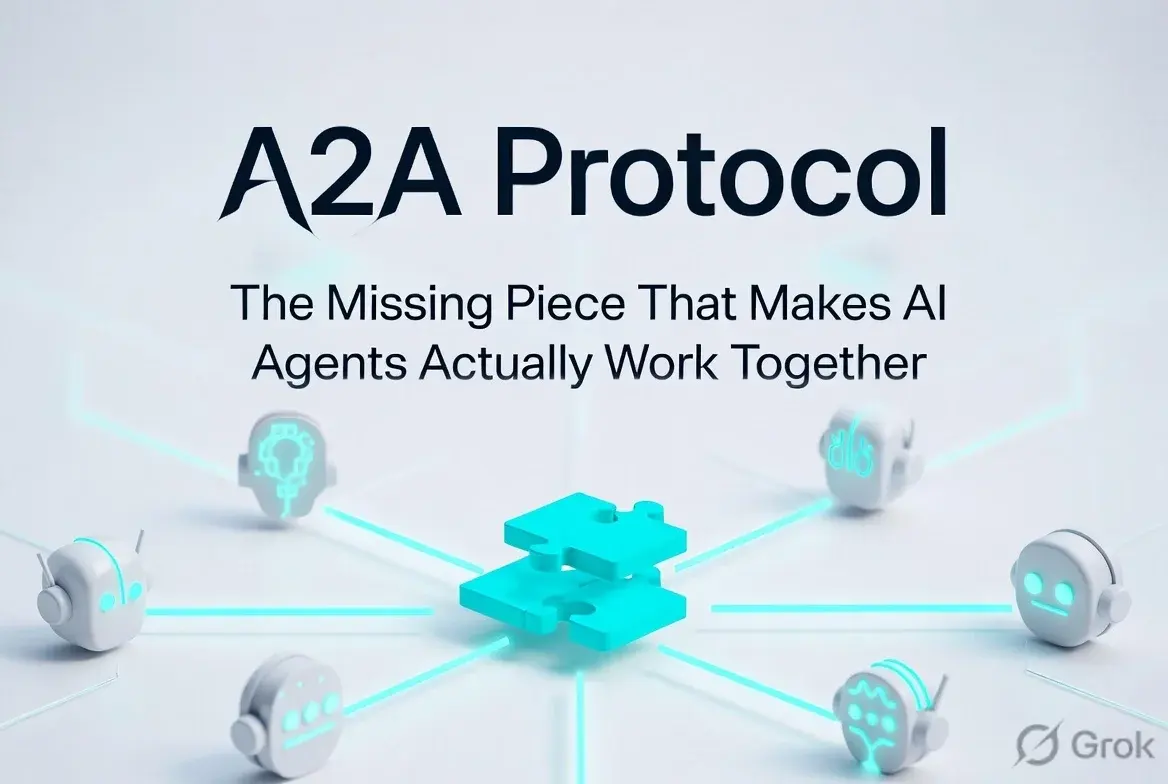
A year ago, Google launched A2A to solve a problem nobody was talking about: AI agents can't talk to each other. Now 150+ organizations say it's the future.
Here's an uncomfortable truth nobody tells you when you're building with AI agents:
Your agent is probably talking to itself.
Not because it's sentient. But because it has no standard way to collaborate with other agents. Different vendors, different frameworks, different servers — it's a Tower of Babel situation. And it's blocking enterprise AI at scale.
The A2A (Agent-to-Agent) Protocol launched one year ago to fix exactly this. And according to fresh data released April 9, 2026, it's working.
What Is A2A, Actually?
Think of A2A as a common language for AI agents.
Created by Google Cloud and donated to the Linux Foundation in June 2025, A2A lets agents built on different frameworks communicate, delegate tasks, and collaborate — without sharing their internal logic or memory.
It's peer-to-peer. Agents work as equals, not in a master-slave hierarchy. They can:
- Discover each other's capabilities via "Agent Cards" (JSON manifests, typically served at
/.well-known/agent.json) - Delegate tasks with full context
- Stream updates back and forth (SSE)
- Coordinate on complex workflows without custom integrations
Google's anniversary post puts it plainly: agents need a common language to collaborate well across diverse systems. A2A is that language. The reference spec on GitHub is the canonical source if you want the protocol details.
A2A vs MCP: The Critical Distinction
If you've heard of MCP (Model Context Protocol), you're not alone. But here's where people get confused:
| A2A | MCP | |
|---|---|---|
| Purpose | Agent-to-agent collaboration | Agent-to-tool connections |
| Architecture | Peer-to-peer | Client-server |
| Think of it as | How agents talk to each other | How agents use tools |
| Best for | Multi-agent workflows | Single agent, many data sources |
The key insight: Most production systems use both.
MCP handles vertical integration (an agent accessing external tools). A2A handles horizontal coordination (agents working together as peers). They're complementary, not competing. For a deeper look at how MCP turns your existing business tools into something an agent can actually call, see our guide on MCP for AI agents.
Gartner's research on multi-agent systems predicts that by 2027, 70% of MAS will use narrowly specialized agents — and standardization is the only way that scales across vendors without N×M custom integrations.
The Numbers Don't Lie
A2A just hit its one-year anniversary, and the adoption curve is steep:
- 150+ organizations now support the standard
- Deep integration across Google, Microsoft, and AWS platforms
- Active production deployments across supply chain, financial services, insurance, and IT operations
- Backed by enterprise giants: Salesforce, SAP, ServiceNow, Workday, Atlassian, PayPal
Without standardized protocols, integrating N agents with M tools requires N×M custom connectors. Early adopters of A2A-style coordination report cutting agent-to-agent integration time dramatically compared to custom development — the difference between a proof-of-concept that demos well and a multi-agent system that actually ships.
Real Use Cases: Where A2A Actually Delivers
Supply Chain Coordination
A logistics company deployed 8 specialized A2A-connected agents for:
- Demand forecasting
- Inventory management
- Shipping logistics
- Customs coordination
Results: 30% inventory cost reduction. 50% faster disruption response.
Each agent handles its domain but coordinates with others via A2A. No custom integrations. No API spaghetti.
Multi-Department Automation
Picture this workflow:
- A planning agent receives a complex request
- It delegates research to a research agent
- Writing tasks go to a content agent
- Data processing goes to an analytics agent
- All coordinate dynamically via A2A
The planning agent doesn't need to know how the other agents work. It just delegates and receives results. This is the same hand-off pattern that shows up in our breakdown of when one agent should hand work to another.
Financial Services Compliance
Real-time compliance monitoring across trading systems. Lightweight A2A communication for instant inter-system coordination — without the custom integrations that typically take months to build.
A2A in Practice: How Subagent Workflows Deliver the Same Outcome
Most teams never need to touch a protocol spec. They want the result: a planner agent that quietly pulls in a research agent when it needs context, a writer agent when it needs copy, and an analytics agent when it needs numbers — without anyone wiring that together by hand.
That's exactly what subagents do inside LotsAgent. You build a primary agent with a clear job. When the work grows past one agent's specialty, it hands off to a subagent that owns that domain. The platform handles discovery, task context, and results delivery. The agents don't need to know what framework the other one runs on.
A single LotsAgent deployment can look like this:
- A triage agent reads incoming Gmail threads
- A research agent pulls context from connected Google Drive docs
- A drafting agent writes the reply in your voice
- A reviewer agent checks tone, accuracy, and policy before send
The triage agent doesn't know — or care — that the reviewer runs a different model. It hands off a result and gets a verdict back. We've walked through a similar pattern in how to build an agent that reads email, makes a decision, and follows up.
This is the practical shape of A2A: agents as peers, working in concert, with the platform handling the glue.
Why This Matters for Your AI Strategy
Here's the uncomfortable reality:
Single agents hit walls.
No matter how capable your agent is, there are tasks that require specialization. A research agent isn't great at writing. A data agent isn't great at customer communication. Forcing one model to be good at everything usually means it's mediocre at most things.
A2A enables what we call agentic teams — specialized agents that collaborate on demand, each doing what they're best at. Accenture's research on interoperability found that companies with highly interoperable technology grew revenue approximately six times faster than low-interoperability peers.
If your AI strategy is "build one really good agent," you're building for 2024. The teams shipping in 2026 build collections of focused agents that know when to hand off — and have the memory and audit trail to prove what happened.
How to Get Started with A2A
-
Understand the stack. A2A uses HTTPS transport, JSON-RPC 2.0, and supports both synchronous request/response and streaming (SSE). You don't need to implement it yourself — most agent platforms expose it for you.
-
Deploy Agent Cards. These JSON manifests (typically served at
/.well-known/agent.json) let agents discover each other's capabilities. Think of it as a digital business card that says "I can do X, Y, Z." -
Start with one workflow. Pick a multi-step process in your business. Identify which parts could be handled by specialized agents. Connect them via A2A — or use a platform that handles handoffs for you.
-
Layer in MCP for tools. Use MCP for agent-to-tool connections, A2A for agent-to-agent coordination. The combination is powerful. Our MCP + durable execution breakdown shows what that stack looks like in production.
-
Monitor with observability tools. Multi-agent systems need proper tracing. OpenTelemetry, audit trails, and durable execution aren't optional — they're how you debug a handoff that went wrong at 2am.
The Bigger Picture
We're witnessing a shift from single-agent deployments to multi-agent architectures.
Mike Anderson from Cisco put it well in the A2A anniversary post:
"A2A has emerged as the syntactic layer that makes agent-to-agent communication reliable and interoperable. What's most exciting is that this is just beginning."
The protocol is the foundation. The applications are the work.
Frequently Asked Questions
What's the difference between A2A and MCP? A2A is for agent-to-agent collaboration — peers discovering each other, delegating tasks, and streaming results. MCP is for agent-to-tool connections — one agent pulling data from or pushing actions into a specific tool or data source. Most production systems use both.
Which platforms and vendors support A2A? More than 150 organizations back the standard, including Google, Microsoft, AWS, Salesforce, SAP, ServiceNow, Workday, Atlassian, and PayPal. The protocol is governed by the Linux Foundation and integrated into the major cloud platforms.
How do Agent Cards work?
An Agent Card is a JSON manifest — usually served at /.well-known/agent.json — that advertises an agent's identity, capabilities, and interface requirements. Other agents read it to decide if this agent can help with a given task, and how to talk to it. It's the machine-readable "business card" that makes peer discovery possible.
Do LotsAgent agents use A2A-style coordination? LotsAgent uses subagents to deliver the same outcome A2A is designed for: specialized agents that hand work off to each other automatically, with the platform managing discovery, context, and results. You describe the workflow; the platform handles the protocol details.
What's the minimum setup to get started with multi-agent workflows? You don't need to implement A2A yourself. On a platform like LotsAgent, you describe a primary agent, define one or more subagents, and the platform wires up coordination, memory, and tool access. From idea to a working multi-agent workflow is typically a single sitting.
Ready to Build Agentic Teams?
A2A solves the collaboration problem at the protocol level. LotsAgent makes it practical for lean teams who don't want to build the protocol stack, the memory layer, the orchestrator, and the observability layer just to get two agents to talk.
With LotsAgent you can:
- Use subagents for agent-to-agent collaboration without touching the protocol
- Give agents persistent memory so context survives across handoffs — see how to manage what agents store and forget
- Connect to 100+ app integrations through OAuth and MCP
- Run on any model — OpenAI, Anthropic, OpenRouter, free models, or BYOK
- Deploy the same agent to Web, Email, Telegram, API, and Webhooks from one setup
- Lean on durable execution for retries, checkpoints, and full audit trails
From idea to a working multi-agent workflow in minutes. No infrastructure to manage.
Create your first agent free →
Founding Early Access is open. Limited spots available.
The protocol exists. The tools exist. The question is whether you're ready to stop building isolated agents and start building agentic teams.
What's your first multi-agent workflow going to be?