 LotsAgent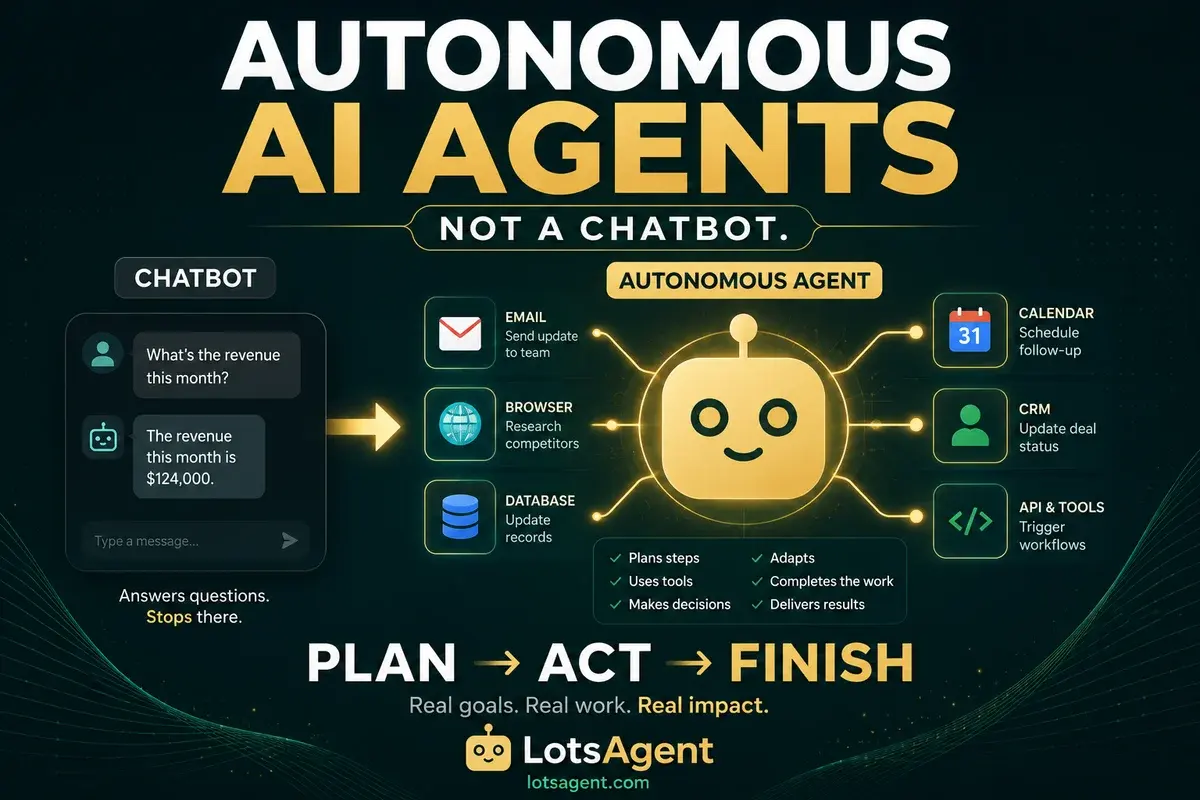
Autonomous AI Agents: What They Actually Do (And What They Don't) in 2026
On 2 August 2026, the EU AI Act's rules for high-risk AI systems become fully enforceable. Article 9 demands ongoing risk management. Article 12 demands automatic event logging. Article 15 demands effective human oversight. For teams shipping autonomous AI agents in production, that date quietly rewrites the contract: a model that takes real action across real tools, with no identity, no audit trail, and no review step, is no longer a defensible choice. It's a compliance gap.
This post is a definitional cornerstone for "autonomous AI agents" in 2026. It defines the term honestly, names the four real levels of autonomy, shows where autonomous execution genuinely saves time, and draws the line at what an agent should never do without a human in the loop. The line we use to draw it is simple: capable agents, accountable to humans.
Four Levels of Autonomy (and the Line That Actually Matters)
"Autonomous" gets used like a marketing badge. In practice, agent autonomy falls into four bands, each with different blast radius if something goes wrong.
1. Assistive. The agent drafts. A human sends. Most "AI assistants" live here. Lowest risk. Highest review effort.
2. Supervised. The agent acts inside a defined envelope. A human reviews the outcome. Common for internal tools, draft emails, summarisation, research handoffs.
3. Bounded autonomous. The agent acts, logs every step, and only stops for a defined escalation trigger — a spend threshold, a low-confidence score, an out-of-policy output. The agent runs unattended inside its boundary and surfaces a review item when it crosses it. This is the band where most production-grade agent work belongs in 2026.
4. Fully autonomous. The agent sets its own goals, chooses its own tools, and decides its own stop conditions. No human review step. No enforced audit trail. In regulated industries, fully autonomous agents are increasingly non-compliant by default. Outside regulated industries, they are still the highest-risk design — both legally and operationally.
The line that separates the third band from the fourth is not a model capability. It's an architectural choice. Does the system enforce an identity, log every action, checkpoint execution, and route specific decisions to a human? If yes, it's bounded autonomous. If no, you're claiming full autonomy and inheriting the risk.
This is the line the rest of the post is built around.
What Autonomous Agents Actually Do Well in 2026
Autonomous execution pays off when the work has three properties: it's repetitive, it's bounded, and the cost of a mistake is recoverable. Three workflows that meet that bar.
Lead qualification and routing. An agent reads inbound leads from a form or inbox, enriches them from public sources, scores them against a defined rubric, and routes the high-fit ones to a sales rep with a drafted reply. The blast radius is small. The output is logged. The rep reviews and sends. Most teams reclaim 4–6 hours a week per operator at this level — and a related pattern is already covered in the email decision-and-follow-up workflow on this blog.
Contract review against a checklist. An agent reads an incoming contract, checks defined clauses (term length, indemnity language, governing law) against a playbook, and flags the deviations. Lawyers review only the flagged clauses. The agent never sends or signs anything. The audit log shows which clauses were checked, which failed, and why.
Scheduled monitoring and escalation. An agent runs on a cron or event trigger, watches a defined signal — a dashboard, a metric, a queue — and surfaces an exception with the context needed to act. It doesn't fix the issue. It doesn't notify customers. It tells a human, with evidence, that something needs attention. This is the cleanest first step for teams that want to test durable execution without putting the agent on the customer-facing surface.
Each of these is bounded autonomous. The agent runs unattended inside a defined envelope. The escalation trigger is explicit. The audit log is complete. The human still decides on the consequential action.
What Autonomous Agents Should Never Do Without Review
Capability without control is a liability. There are four categories of action an autonomous agent should not take on its own in 2026, regardless of vendor claims.
Irreversible external actions. Anything that can't be cleanly undone — sending money, deleting data in production, revoking access, publishing a public post, deploying code to a live system. Bounded autonomy is the right framing: the agent prepares the action, the human confirms. The operating model for accountable automation covers the ownership questions that go with this.
Customer-facing communication above a defined threshold. Mass emails, refund offers, churn interventions, anything that affects a customer relationship at scale. The cost of a tone-deaf or wrong-content message is too high to delegate without a sample-review loop.
Anything with legal or regulatory exposure. Contract execution, compliance filings, regulated disclosures. This is now a hard line under the EU AI Act for high-risk systems, and a soft line worth keeping for almost everything else.
Decisions the system can't explain. If the agent can't produce a clean, logged reason for an action — what it read, what it decided, what tools it used, what it didn't do — the action is not bounded autonomous. It's a guess with consequences.
The audit-step mental model is the practical check: every irreversible action should have a corresponding log entry that a human can read, in plain language, without reverse engineering the agent. If that log doesn't exist, the action isn't bounded — it's exposed.
How LotsAgent Draws the Line
LotsAgent is built on a specific belief. Capable agents do real work — connected to real tools, running on persistent goals, executing across your stack. But capability without control is a liability, and that's a non-negotiable design constraint.
Concretely, every agent in LotsAgent has:
- A complete identity — name, role, goals, system prompt, and a human owner assigned at creation.
- A full execution history — every tool call, every decision, every retry, checkpointed end-to-end. Durable execution means the audit trail survives the agent failing and restarting. A deep dive on the mechanics lives in the durable execution explainer.
- Scoped permissions — agents act only inside the tools and permissions the user configures. No tool is available by default. The agent doesn't reach outside the boundary.
- Defined review steps — the owner chooses which actions require a human confirmation: an external send, a payment, a publish, a delete. The platform enforces that choice every time the agent runs.
- Multi-channel deployment with the same control — web UI, email, Telegram, API, MCP, and webhooks, all running the same agent with the same audit trail. A complete picture of what MCP turns into in production is useful background here.
LotsAgent is not a fully autonomous system. The Agent Builder configures capable agents from a conversation. The Agent Improver proposes improvements to its own configuration. Neither runs without a human reviewing the change. "Agents that act, humans who decide" is not a tagline — it's the system design.
The same platform runs LotsSocial, LotsBlog, LotsTeam, and the rest of the LotsTech ecosystem. That is the real proof the model works: production agents, accountable to humans, scaling inside products that ship to real users every day.
What "Autonomous" Means for Your Stack
If you're choosing where to put autonomous agents in 2026, the practical framework is short.
Start with bounded autonomy on workflows that are repetitive, scoped, and recoverable. Add a review step on every action that crosses the cost-of-mistake threshold. Make the audit log a first-class deliverable, not a side effect. Decide which actions the agent can take on its own and which require a human in the loop — then enforce that decision in the platform, not in a prompt.
Fully autonomous agents are a real capability. They are also a real liability, and the regulatory environment is catching up. Bounded autonomy — capable agents, accountable to humans, with the audit trail to prove it — is the only design that holds up in 2026.
Create your first agent free at lotsagent.com. The platform is built to enforce the boundary. The autonomy is yours to scope.
FAQ
What is an autonomous AI agent? An AI agent that takes action across tools and systems with limited or no human input per step. In 2026, the meaningful distinction is between bounded autonomous agents (defined envelope, audit trail, review step on consequential actions) and fully autonomous agents (open-ended goals, no enforced human oversight). The first is production-ready. The second carries the highest legal and operational risk.
Are autonomous AI agents safe? Bounded autonomous agents are safe for the workflows they are scoped to. Fully autonomous agents, with no identity, no audit trail, and no enforced human review, are increasingly non-compliant under frameworks like the EU AI Act (Articles 9, 12, 15) and remain a high-risk design for any consequential action. Safety in 2026 is a property of the system's enforcement — identity, permissions, audit log, review step — not of the underlying model.
What can autonomous AI agents actually do in 2026? In production today, autonomous agents reliably handle bounded, repetitive, recoverable work: lead qualification and routing, contract review against a checklist, scheduled monitoring and escalation, multi-step data enrichment, and cross-tool task handoffs. They do not reliably handle irreversible external actions, high-stakes customer communication, or anything with legal exposure without a human review step in the loop.
What is the difference between an AI agent and an autonomous AI agent? An AI agent can take actions through tools. An autonomous AI agent does so within a defined envelope without per-step human input. Most "agents" in production today are supervised or bounded autonomous. The category is a spectrum, not a binary — and the production-ready design lives in the bounded band.
Do autonomous AI agents need a human in the loop? For any consequential or irreversible action, yes. Bounded autonomy in 2026 means the agent runs unattended inside its scope and escalates to a human on a defined trigger. That is the design pattern that satisfies Article 15 of the EU AI Act and that the EU AI Act for AI Agents post walks through in detail.