 LotsAgent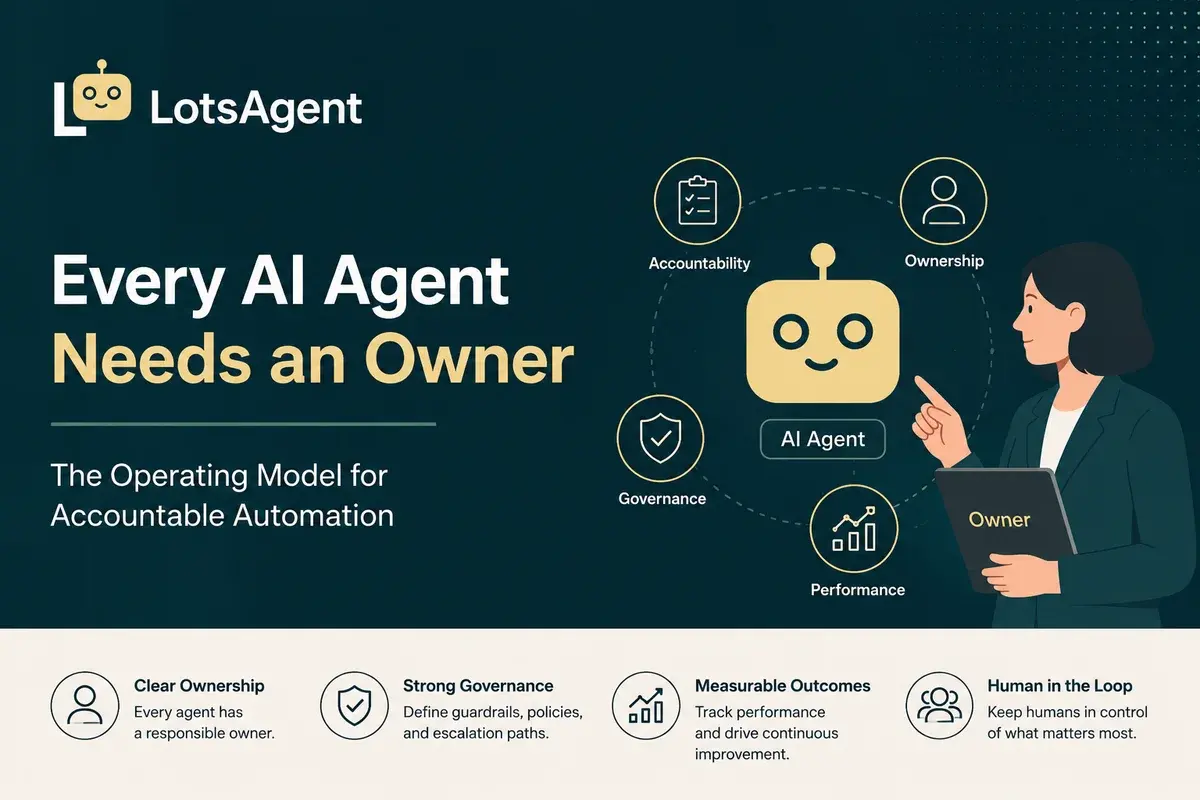
An AI agent without an owner is a liability with an API key. The agent will execute. It will spend. It will send. The question is never whether it acts — it is who is responsible when it does.
That ownership question used to be theoretical. It is not anymore. By 2027, 40% of enterprises will demote or decommission autonomous AI agents because governance failures made them untenable, per Gartner's May 26, 2026 forecast. Tigera's 2026 research is sharper: 80% of organizations have already encountered risky AI agent behavior, but only one-third have governance maturity to match. The agents are running. The accountability is not.
The fix is not less autonomy. It is an operating model with one named human per agent, tighter boundaries, and an audit trail you can hand to a regulator, a customer, or your own postmortem. This is the operating model that makes an agent something you can actually run unattended.
What "Accountable Automation" Actually Looks Like
Picture a concrete workflow — the kind a real founder or ops lead is shipping this quarter.
A support agent named support-triage runs on LotsAgent. It has its own email inbox, a Gmail tool, a Slack tool, a refund tool connected through MCP, and a notion memory. Its job: read every new support email, classify it, draft a reply, and either send the reply or escalate to a human depending on the rules its owner wrote.
The owner is one named human — say, the head of support. She does not have to wire the agent's identity, scope, audit trail, or review gates herself. LotsAgent ships those out of the box. She has to do three things:
- Set the agent's identity: name, role, system prompt, which tools it can touch, which it cannot.
- Write the approval gate: refund under $50, fire autonomously. Refund over $500, draft a reply and ping her in Telegram. Email a customer, draft only. Email a colleague, send directly.
- Read the execution log every Friday. Not skim — read. The platform captures every prompt, every tool call, every output, every override. If something looks off, she tightens the scope or revokes the tool.
If she goes on vacation, the secondary owner picks up the same log and the same pager. The agent does not get smarter while she is gone. The blast radius is the same. That is the test.
That is the operating model. Everything else in this post is a way to make sure your version of it actually holds in production.
The Operating Model for Accountable Automation
Accountable automation does not mean agents that wait for permission on every step. It means an operating model with five parts, each of which an owner is responsible for:
- Identity — who the agent is, what it can do, and what it cannot do
- Scope — the tools, data, and channels the agent is allowed to touch
- Review — where the agent must pause and ask a human before acting
- Audit trail — a complete, exportable record of every action, decision, and tool call
- Escalation — a named person, pager, or runbook for when the agent goes off-script
If you cannot fill in all five for a given agent, you do not have a deployed agent. You have an unowned script with a chat interface.
Why "We Have a Security Team" Is Not a Plan
The most common defense when an AI agent misbehaves is "our security team reviewed it." That is not ownership — that is a rubber stamp. Security review answers whether the system could be deployed safely. Ownership answers who is on the hook after deployment, when the agent encounters inputs and contexts no review can predict.
McKinsey's 2026 state-of-AI survey found that organizations reporting "meaningful cost reductions" from AI are roughly 2× more likely than peers to assign clear human ownership of AI outputs. The lift is not from better models. It is from someone whose job depends on the result.
This is the part most deployment plans skip. They define the agent's tasks. They define the tools. They do not define the human. And the agents that do real work — reading your inbox, calling your payment API, sending customer messages — are the ones that need the human defined most of all. If you are shipping any of those workflows, the 30-minute AI agent audit is the fastest way to find the ownership gap before it costs you.
The Five Questions a Named Owner Must Answer
Pick an owner for every agent you ship. The owner is one human, with a name, a role, and a way to be paged. Their job is to answer these five questions, in writing, before the agent is enabled in production:
- What is the blast radius? If the agent runs without a human in the loop for an hour, what is the worst it can do? Spend money? Send messages? Modify a production database? Delete a customer record? If the owner cannot name the worst case, the scope is too wide. (The memory-control post covers the related question of what the agent should remember at all — different problem, same posture of explicit choice.)
- Where is the kill switch? Not "we can shut it off." Where, specifically, is the toggle, who has access, and how long does it take to stop the agent from acting? "A few minutes" is not a kill switch. "A credentialed human can revoke the agent's auth token in under 60 seconds" is.
- What is the approval gate? Which actions require a human to sign off before the agent executes, and which are allowed to fire autonomously? Refund under $50, autonomous. Refund over $500, review. Email a colleague, autonomous. Email a customer, review. Without this list, the agent's autonomy is defined by accident, not by you. A real-world version of this list — for an agent that reads email, decides, and follows up — is in the email-decision-followup workflow guide.
- What does the audit log capture? Every tool call, every prompt, every output, every override. If you cannot produce this log on demand for a regulator, a customer, or your own postmortem, you do not have an audit trail. You have noise.
- When do you, the owner, get paged? What is the trigger — a failed action, a confidence score drop, a customer complaint, a spending threshold? If the owner is never paged, they are not an owner. They are a figurehead.
A useful test: if the named owner goes on vacation for two weeks, does the agent continue to operate safely? If the answer is "we do not know," the ownership is decorative. The identity post makes the same point at the agent level — an agent with no identity cannot be owned, audited, or revoked.
What the Good Operating Models Look Like
A handful of patterns are starting to work in production. They are unglamorous, which is why they work.
Stripe's agentic payment credentials — Stripe's Agentic Commerce Suite treats every AI-initiated charge as a distinct actor. The headline mechanism is the Shared Payment Token: a scoped, network-tokenized credential the agent uses instead of a raw card number. The agent never holds the buyer's real payment method, the token is scoped to a specific merchant and amount, and Stripe's agentic-commerce disputes post shows the same posture applied to the dispute layer. The principle: the agent is an identity with limits, not a privileged user.
Shopify's Sidekick merchant agents — Sidekick is Shopify's built-in merchant AI assistant. The product is designed around the merchant as the owner: every consequential action (editing a product, refunding an order, sending a customer message) is gated behind explicit merchant-controlled permissions, and the merchant is surfaced as the principal in the UI, on every consequential action. The agent is never the principal — the merchant is.
Internal engineering and SRE teams have been running this playbook for years under a different name. Google's SRE on-call chapter and the Google SRE automation chapter lay out the shape: a background automation runs in a sandboxed service account, every action is logged to an append-only store, and a named on-call human owns the automation's behavior for their shift. The AWS Builders' Library applies the same posture to "operational ownership" of services. The lesson for agents: stop treating them as a new category. Treat them like the existing automation they are about to replace — same ownership, same audit posture, same on-call rotation.
What Breaks Without a Named Owner
The failure modes are not subtle. They are the same ones that hit unowned scripts a decade ago, only faster and at higher volume:
- Runaway spend. An agent with a payment tool and no spending cap, executing in a loop because of a prompt injection. Stripe's agentic-commerce disputes post exists precisely because the volume of agent-initiated disputes is now large enough to be visible on a card network.
- Off-brand comms. An agent authorized to email customers, sending messages no human reviewed, in a tone that does not match the company. The reputational cost lands on a team that did not know the agent existed.
- Silent data exfiltration. An agent with read access to a CRM, prompted (or prompt-injected) to summarize and forward records. The audit log, if it exists, is the only thing that tells you anything went wrong.
- Regulatory exposure. The EU AI Act and US state-level rules are converging on a simple ask: name a person. If you cannot, the deployment is non-compliant by default.
The cost of any of these is larger than the cost of naming an owner upfront. The math is not close.
A 30-Minute Exercise to Find the Gaps
Before you ship another agent — or audit the ones already running — do this. It takes half an hour and a whiteboard.
- List every AI agent currently acting in production. Not the demos. Not the prototypes. The ones with real credentials.
- For each, name the owner. One human, with a name, not a team. If you cannot, that is the gap.
- For each owner, ask the five questions above. Write the answers down.
- For every question the owner cannot answer, decide: tighten the scope, or assign the human. Do not leave it as "we will figure it out."
- Repeat in 90 days. Agents change scope. Owners change roles. The operating model has to be re-checked, or it decays.
The point of the exercise is not compliance theater. It is to make ownership falsifiable. If the named owner cannot answer "what is the blast radius" for their agent, the agent is not owned. It is just running.
How LotsAgent Fits the Model
You can run the five-part model on any platform that gives you identity, scope, review, audit trail, and escalation. The point of this post is the model, not the vendor.
That said, the friction in most of the agent platforms we looked at is real: identity, scoped permissions, and durable execution are weeks of infrastructure work before your first agent does anything useful. Most teams burn their first month reinventing it. LotsAgent ships those pieces out of the box so the model above is something you can configure in an afternoon and run the same week. Every agent has a complete identity, persistent memory, a full execution history, a configurable approval gate, and a Telegram / email / webhook escalation channel. For technical readers, the API and MCP docs cover the durable-execution and identity plumbing in detail. For everyone else: the platform-checklist post walks through what to look for in any agent platform against this exact five-part model.
The point of the model is not the platform. The point of the model is the named human.
Frequently Asked Questions
Who should be the named owner of an agent on a small team? The person whose job is on the line when the agent acts. On a small team that is usually the operator closest to the work — head of support for a support agent, head of sales ops for a pipeline agent, founder for the catch-all. The owner must be one human, not a team. Teams do not get paged. People do.
What does an audit log need to capture to be defensible? At minimum: every prompt the agent received, every tool it called, every input and output, every human override, and the timestamp. To be defensible it has to be exportable in one place, immutable to the agent, and readable by someone who did not build the system. If you cannot hand the log to a customer or a regulator and answer "this is exactly what happened" within an hour, it is not a real audit trail.
How do I write the approval-gate list for a new agent? Start from the worst case. For each tool the agent can touch, ask: at what dollar value, what recipient, what content type, or what irreversibility threshold should a human approve? Write it as a one-page table. Refund under $50 — autonomous. Refund $50–$500 — Telegram ping the owner. Refund over $500 — draft only, queue for review. Email a colleague — autonomous. Email an external customer — draft only. Anything that touches money, identity, or external comms starts on the review side. You can loosen it later with evidence.
What is the smallest viable operating model for a single agent? Identity + scope + one human owner who can revoke auth in under a minute + one place where the execution log is stored. That is the minimum. If you skip any of those four, you do not have an agent — you have a script with no operator.
How does this model scale to subagents and multi-agent handoffs? The owner of the parent agent owns the handoff. Each subagent inherits the parent's scope by default, plus a tighter sub-scope you write explicitly. A subagent never gets more scope than its parent. The parent agent's audit log captures the handoff event so you can see which subagent did what, when, on whose authority. If a subagent goes off-script, the parent's owner paged — not the subagent's "owner" (subagents do not have owners; the parent does). The agent orchestration post goes deeper on the handoff mechanics.
The Short Version
The agents are already in production. Gartner says 40% will be rolled back by 2027 because no one owned them. Tigera says 80% of organizations have already seen risky behavior. The fix is not more policy documents. It is one named human per agent, with an identity, a scope, an approval gate, an audit log, and a page when things go wrong.
You bring the named human. The platform you run it on handles the rest — identity, scope, audit trail, and the channel your owner reads on a Friday afternoon. Create your first agent free at lotsagent.com, or for technical readers, start in the API docs and the MCP integration guide.
That is the operating model. It is not exciting. It works.